MISS LILLIE KITTRIDGE, a pretty and unsophisticated girl, set out, one fine afternoon, to climb a hill that overlooked the ancient and picturesque New England village of Dereham.
The hill was rocky and abrupt, too steep for cultivation, but prolific of blackberry and raspberry vines, and all manner of wild flowers. Miss Lillie had been contemplating this expedition for several days; and now the cool breeze and the bright sunshine, modified occasionally by soft, white clouds, presented just the conditions she wanted.
She was alone. She was new to the country, and had made no acquaintances. Her father, the Reverend Holland Kittridge, had brought her mother and herself to this sequestered region for a month’s vacation.
It was the old people’s silver honeymoon; they had been married twenty-five years, and Dereham was the place where they had first met. It was full of tender reminiscences for them. They were always addressing remarks to each other beginning with, “Don’t you remember — ?”
They were quite as unsophisticated as their nineteen-year-old daughter. Their life had been peaceful and uneventful, out of the current and influence of the world. Dr. Kittridge’s sermons were generally a proclamation of good tidings of great joy. Evil was a metaphysical abstraction to him; at most, a historical phenomenon. It had no part in his own experience, and he scarcely realized its actual existence. At any rate, sin and hell were words that seldom came from his mouth, in the pulpit or elsewhere.
Lillie had never before been in Dereham, and had no reminiscences or associations to contemplate. Perhaps she was not averse to creating some. Hearing her father and mother converse so much about their early love episodes, may have suggested to her that it would be pleasant to have a lover of her own. But, as no suitable person seemed to be at hand, she fell back upon nature, and went up the hill to enjoy it.
Her progress was slow, partly because the hill was so steep, but more on account of the blackberries and raspberries. At last, she found herself high aloft, near the top of a rocky gorge.
The view was splendid. She could see the whole village of Dereham, with its great elm trees, its winding brook, the gleam of the pond further off, and the narrow, level sweep of the railroad on the south. And there was the very farmhouse where she and her parents were boarding. She recognized it by the two huge butternut trees that stood sentinel on the front grass plot. From here, they looked no larger than cabbages. That white dot between them must be her mother, and that moving speck, her father, pacing up and down, as his after-dinner habit was, and bubbling over with placid, optimistic talk.
Lillie thought how good her father was. and wondered if all men were as good as he.
“I should like to see some wicked man sometime,” she said to herself; “some nice, wicked man, I mean; and then I should like to be a little bit wicked myself, just to try!” Having breathed this aspiration, she blushed, and felt that she had been rather wicked already.
She turned her eyes away from the village and looked up the hill. The summit did not seem far off; she would mount to the very apex, and thence look down upon the world and the kingdoms of it.
But she had not taken a dozen steps when, in a deep hollow on the left, she caught sight of what was really the finest raspberry bush she had yet seen. She had already eaten berries enough, but these were too good to be passed without a taste; so, with some difficulty, she got down into the hollow, with her skirts gathered up in one hand, and the other outstretched for the fruit.
Before she could touch the first berry, however, she heard a sound that caused her to start and shrink back. She had never heard such a sound before; but instinct warned her that it meant mischief. It was a whirring or buzzing sound, somewhat like what might be made by vibrating the tongue behind the teeth.
She glanced downward, and there, coiled underneath her feet, with its head upright, and its bony tail quivering, she saw a great rattlesnake. It was not three feet off. Lillie uttered a piercing scream, and sprang backward. But her foot trod on a stone, and she fell.
MEANWHILE, down at the farm-house, Dr. and Mrs. Kittridge had a pleasant surprise.
While they were conversing cosily beneath the butternut trees, they saw a tall, massive figure coming towards them, across lots, from the village. As he drew near, he took off his straw hat and waved it, and made other gestures of friendly recognition. Evidently, it must be some one they knew.
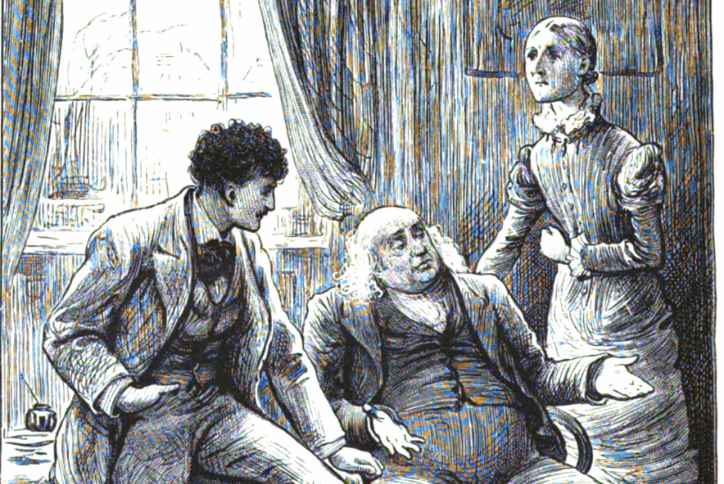
“Why, Silvia,” said Dr. Kittridge, narrowing his eyes, while a smile began to glimmer and broaden over his mouth, “I believe — I do believe — yes, it is! It’s Buckminster Horne, who was with me in college! You’ve met him — Judge Horne, you know. Why, Horne, my dear fellow, we are so glad to see you! Where did you come from? How do you do? Sit down; sit down! You know my wife?”
Judge Buckminster Horne, of the court of common pleas, was a majestically-made personage, tall and strong, and of a Websterian cast of countenance. He was about fifty years of age, and at the prime of his powers and reputation. No juster or more learned judge ever sat on the bench. He was a man of the world in the best sense of the term, wise, kindly, courteous, keen. He and Kittridge had been friends from their youth; though, since college days, they had met but seldom. Their respective experience and views of life were widely divergent. Kittridge reasoned deductively, from the standpoint of his own pure heart and hopeful mind. The judge was mainly inductive in his method. He knew the depths of human frailty, and, though the knowledge did not make him cynical, it prompted a wise respect for the restraints and conventions upon which modern civilization is based. He contemplated with mistrust the growing freedom of social observances, which the clergyman, with his optimistic notions, was inclined to advocate.
The conversation between the three friends immediately became animated and cordial. The judge explained that he had come down for a few days’ fresh air, without knowing that the Kittridges were here; and congratulated himself on the happy chance, and them on the anniversary they were celebrating. He complimented Mrs. Kittridge on her youthful and comely looks, and remarked that, if she had a daughter, the young lady would have to exert herself to retain her admirers.
Mrs. Kittridge, in fact, was a very pretty woman, and her forty-five years hardly seemed thirty. Her cheeks grew pink at the great judge’s flattery; but she feigned resentment, and said :
“The way to be polite to a mother is to remember her children. I don’t know what Lillie will do to you when I tell her that you have forgotten her existence!”
“Why, bless my soul!”’ murmured the judge, arching one of his shaggy eyebrows; “to be sure! I remember her as a baby; and then — let me think! — was it seven years ago I saw her last? Dear, dear! Why, the child must be nearly twenty! I wish wecould stop these youngsters from growing, Kittridge!”
“For my part, the older I get, the better I like it,” said the clergyman.
“You don’t know how to be old. That’s your great defect! But about Lillie: where is Lillie?” demanded the judge, putting up his eye-glasses and looking this way and that.
“She has gone for a walk up the mountain,” replied Mrs. Kittridge.
“Ah!” murmured the judge, fixing his gaze upon the picturesque height in question. “Did she go alone?”
“Oh, to be sure,” said Kittridge. “ She can take care of herself.’’
“Yes; the danger will be when she comes to entrust herself to other hands. However, I have no objection to the mountain. A mountain is a better companion for a pretty girl than a young man, as the world goes.”
“We shan’t agree with you there!” returned the good doctor. “When Sylvia and I met here, twenty-six years ago, we thought each other the best and safest companion possible; and I recollect, Sylvia,” he added, turning to his wife, “that it was on just such a day as this that I first found you on the mountain, picking blackberries.”
“I remember; and you asked me whether I would give a poor man some work; and then you began to help me fill my pail.”
The husband and wife looked at each other and laughed.
“Yes, that was all very well,” said the judge; “but all young men are not like Holland Kittridge. If I had a daughter, I would’t risk her on the chance of there being even one more like him.”
“Wait till you have a daughter, and then see!” the clergyman rejoined. “Your profession, my dear Buckminster, has sapped your faith in human nature. We are the children of God; and the less we are hampered with artificial restraints, imposed by suspicion and corruption, the better and happier we shall be.”
“Well, well! You’re incorrigible,” said the judge, with his deep, low laugh. “You’re the same theorist you were in college; and, if you had been a man of action, you might have led a band of Communists into the wilderness before now. I don’t deny the suspicion, or the corruption, either. But the restraints they impose never injured a pure soul, and often balk an evil one. They prevent; they don’t aim to regenerate.”
“A pure soul is safe in any case,” said Mr. Kittridge. “It can fall only by its own act. But what surer way is there to purify an evil heart than to appeal to the goodness that is always in it? The best encouragement to a thief not to steal is to treat him like an honest man.”
“Only a millionaire could afford indulgence in such business,” rejoined the judge, with a kindly smile gleaming in the caverns of his eyes. “But, granting that, the principle would not apply to the association of the sexes. That is a matter by itself. The springs that influence it are as wayward and incalculable as they are deep. It cannot be hedged about too carefully. A man may mean no harm at first, and yet find himself drawn on and on, till — But this is a hobby of mine, and not a Pegasus by any means; and, therefore, not able to lift me to the heights where spirits like yours commune. When do you expect Lillie back? If you will permit it, my dear Mrs. Kittridge, I will make a practical recantation of my heresies by falling in love with her forthwith!”’
“She will never return your love, if you take her to drive behind your hobby,” said the lady, with a slight gravity of tone; for the judge’s sonorous disquisition had troubled her a little. “Lillie has always gone on as if the golden age were her birthright; and we think that she has hastened its approach by doing so. Ah! There she is now! But who is that gentleman beside her?”
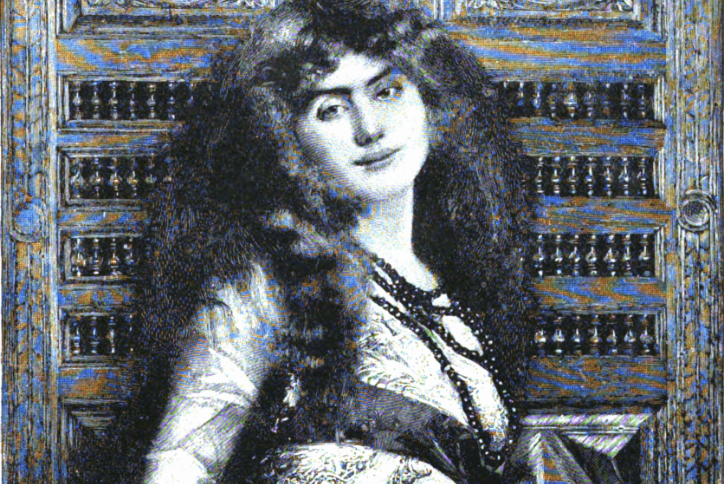
In fact, Lillie was approaching, with her brown straw hat, her dark blue linen dress with white spots, her fresh, rosy face, and her dark hair and eyes. Beside her walked a well-made young man of medium height, with a grave, dark, delicately-moulded countenance, and a close-fitting, belted suit of gray tweed. He bore in one hand a folding easel and paint box, and in the other a hickory cudgel, on the cleft end of which, carried over his shoulder, was a large dead rattlesnake, about four feet in length.
“Why, Lillie, dear!” said her mother, as the girl came up, with a glance of anxiety at the young man and the serpent, and of trusting interrogation at her.
“This is Mr. Keith Rantoul, mamma,” said the daughter, with a smile and a blush. “He saved my life up on the mountain. I brought him here for you to thank him. Mr. Rantoul, this is my mother and father, and — and — oh, and Judge Horne!” she added, after a moment’s hesitation, smiling at the judge, and holding out her hand.
“Thank you, my dear,” said he, taking the soft, sun-browned little fingers in his broad palm. “You remember like a princess!” He bowed courteously to Mr. Rantoul, but accompanied the bow with a searching glance.
The young man bore himself with quiet self-possession. He greeted the three elders easily and gracefully.
“I have brought my credentials, such as they are,” he remarked, showing the snake. “I was sketching up yonder, and heard Miss Kittridge cry out. I attacked this fellow from behind, and punished him for his incivility. No one is under any obligations, except myself, to the good luck that brought me there!”
“We thank Providence and you, with all our hearts,” exclaimed the reverend doctor, grasping Rantoul’s hand cordially. “Sylvia, we must make this gentleman stay to supper.”
“Indeed, I hope you will, Mr. Rantoul!” said the mother, with gentle earnestness.
“You are very kind; but you must excuse me this evening,” he replied. “I am stopping at Reynolds’ farm, a couple of miles away to the north. If you will allow me, I will call in a day or two.”
He bowed again slightly, with a faint smile on his delicate lips; but, as he turned to go, his black eyes rested for a moment on Lillie with peculiar intentness; and her smooth, clear cheeks reddened under the glance. Only the judge noticed this passage, however. The next moment, Rantoul was gone.
He remained, nevertheless, as the topic of conversation. Lillie gave an animated and detailed account of her adventure, and portrayed her rescuer in all the colors of a hero. She was not quite so particular in her record of the conversation that ensued between them afterwards; she dismissed that in general terms. But, again, it was the judge alone that marked the omission; and he forebore to draw attention to it. The father and mother were interested and sympathetic.
“He is a good fellow, well bred and well conducted,” said the doctor. “I like him. I hope he’ll come again.”
“It’s something like our first meeting, isn’t it?” remarked his wife. “That was on the mountain, too; and I was picking blackberries.”
“There wasn’t any serpent, though, in your case,” observed the judge, in a musing tone.
“Well,” he added, “I dare say we shall see more of Mr. Rantoul. What did you say his first name was, my dear?”
“Keith,” Lillie replied. But the moment after she wished she had not answered so promptly.
The fortnight that followed was a memorable one for Lillie. She had never been so happy: and yet there were times when she was anything but happy. But, at all events, life had become passionately interesting to her. She was constantly sensible of a warm, strange excitement, which quickened her pulses, brightened her eyes, and colored her dreams. Every breath she drew was taken with the thought of Keith Rantoul.
He was with her every day. They had long walks and talks together. He revealed a new world to her. There was an element of secrecy in these communications. Not that he enjoined reticence upon her; but she felt that it would be impossible to repeat what he said to her father and mother; they would not have comprehended it; it was not suited to them. It was the talk of a man who knew the great world, who had had sorrows and wrongs, who was neither submissive nor immaculate, but whom she loved with all her soul.
Ever since she had ceased to be a child, she had vaguely craved some stronger and racier food than the manna of virtue and piety that her parents’ table afforded; and the cup that Rantoul held to her lips was not less delicious because intoxicating. She neither knew nor cared whether it were conventionally wholesome; she drank it because she wanted it.
Nor was there ever anything to offend delicacy in Rantoul’s speech or behavior. Beneath his every manifestation there was always the instinct and quality of a gentleman. But this polish and reserve only made more forcible the influence he exerted over Lillie. She felt in him a refined, but rebellious and saturnine spirit, intensely masculine, concealing some secret wound, and scoffing at it and at himself; but withal, at times, passionately tender and humble.
She longed to help him, to comfort him, to sympathize with him; in some way, to give herself to him as compensation for his unknown suffering. And all this tragi-comedy was enacted in the glorious days and evenings of the New England summer, with youth and health on both sides, and, on one at least, the insatiable freshness of innocence and hope.
Dr. and Mrs. Kittridge, meanwhile, knew Rantoul as a cultivated and agreeable man, familiar with good society, and fond of art. He was evidently well off, and he was his own recommendation of respectability. He made no attempt to enhance his value in their eyes; but whatever came to light about him was creditable.
Instead of spending his time in dissipation and extravagance, he was here among the New England hills, breathing pure air, painting meritorious sketches in water-color, and evidently feeling a peculiar interest in their daughter Lillie. It was impossible not to foresee that this interest, for a man of his age and character, might culminate in a marriage.
The father and mother watched the progress of the romance with the feeling that it was the reproduction of their own youthful love affair; and, in it, they renewed their youth. They did not interfere, either to promote or to restrain. They had faith that true love would work out its own happy consummation. They always welcomed Rantoul cordially and trustfully, when he came to ask if Lillie would go to walk with him; and saw her depart without reluctance or anxiety. When she returned home, she was not upbraided for being late, or subjected to a cross-examination as to where she had been and what she had been doing. They remembered their own early love secrets, and forbore, assured that all would be revealed in the proper time and place.
But the Hon. Buckminster Horne did not altogether share this paradisical equanimity.
“I bring no charges against this young gentleman,” he once said, “because I know nothing about him, any more than you do. But suppose, when the time comes for him to return home, he should simply say good-bye, and be off. Nobody could blame him; no one has ever asked him his ‘intentions’; but what would become of your daughter? She is in love with him, and, whether he has ever told her so or not, she takes it as a matter of course that he means to marry her. She has never been in love before; do you imagine he never has been? To say the very least of it, my good friends, you are risking her happiness and her faith in human nature for life.”
“Love is not like a matter of business,” replied the doctor, undisturbed; “ it’s origin is divine, and it bears its own divine safeguard with it. It can work miracles, as the scripture tells us; but it will need no miracle for these young people to find their happiness in each other.”
“Still, Holland,” said Mrs. Kittridge, whose maternal solicitude the judge’s words had perhaps a little stirred, “it might be as well to speak to Mr. Rantoul, and invite him to give some expression of his views about himself and Lillie. Very likely he would be glad of the opportunity, if, as I am sure is the case, he means to do as we expect.”
“Give them time, give them time, my dear!” returned her husband, smiling and shaking his head. “I know how it is with them. They think we are all so blind, we have no suspicion what they are about; and they are enjoying the fun of a secret engagement; that’s all. Why shouldn’t they? Don’t you remember that we kept our engagement secret, or fancied we did, for three weeks? And wasn’t it one of the most delightful and edifying experiences of our lives?”
As Mrs. Kittridge could not deny this statement, her opposition ceased; and the judge, thoroughly discomfited, walked off to smoke a cigar in solitude.
What were Keith Rantoul’s real designs in this matter?
One afternoon he and Lillie were on the mountain together, near the spot where they had first met. They sat on a rock overlooking the village. The sun, half way down the sky behind them, cast the great shadow of the mountain over the landscape at their feet.
“Lillie,” said Keith, digging in the turf with the point of his cane, “do your father and mother know that we’re in love with each other?”
“They have never said anything to me about it,” Lillie replied.
“Do they think we are engaged?” he continued, keeping his eyes away from her.
“They haven’t asked me, Keith; and I’ve never said anything about it, of course.”
“Perhaps you haven’t thought anything about it, either” he said, now turning his eyes on her.
“ It isn’t my part to — to think about, until you ask me to!” answered the girl, faltering a little.
There was a pause. Presently he said:
“What if I told you I’m going away tomorrow?”
“Do you mean not to come back again, Keith?”
“Certainly!” he replied, between his teeth.
She gazed up at him, and grew pale.
“I couldn’t bear not to see you again!”
“It was the worst day in your life, when we first met!” said he, with repressed fierceness. “Why have your father and mother let this thing go on? What do they know about me? What do they suppose you are? I haven’t kept myself out of their way; I have given them every chance to ask me who I am, and what I wanted. If they had asked me, as I’m a living man, I’d have told them the truth! They are to blame, not I!’
“Why, Keith, what is the matter? What is wrong?” she asked, in a husky voice.
“What is wrong? Everything! You love me, to begin with; and I love you, with every drop of my blood and impulse of my soul! I don’t pretend to self-abnegation, but I have struggled against it from the beginning; and this is the result! Well, I’m going tomorrow, never to come back; but whether we part or not is another question, and you shall decide it!”
They both rose to their feet and looked at each other.
“What reason is there we should part?” she asked at length.
“No reason, in my will! If you come with me, I will love you and serve you to the end of my life, or yours. I will defend you against the world, and do my best to be all the world to you. If I alone can satisfy you, you will be happy. But you must give up everything else, your father and mother, your friends, society, everything! You must not even say goodbye, or tell them where you are gone. Do you love me enough for that? Say ‘no,’ and you will never see me again!”
“Oh, Keith, you know I love you!’ she said trembling. “I could leave everyone for you; but don’t ask me to do anything that would make me ashamed to be my mother’s daughter!”
He hesitated a moment. But he had gone too far. His breast was on fire. He crushed down the nobler impulse.
“I did not make society,” he thought to himself. “It has done its best to ruin me. I owe it nothing!”
He took Lillie in his arms and kissed her quick and hard, again and again.
“I ask you to do nothing,” he said, “which, before God, and as a human being, you have not a right to do! Trust me, and come!”
They went down the mountain together, and parted at its foot — to meet again.
Two days previous to this, Judge Horne had received a letter from New York that compelled his immediate presence there. He was as prompt and active in his movements as a soldier. A train was leaving in an hour. He packed his trunk, bade farewell to his friends, and departed. Traveling all day, he reached the city that evening, and met his business agent at dinner at the club.
In the course of the conversation, a lady’s name happened to be mentioned, in connection with a social scandal that had lately come to light. ‘The judge, without any change of voice or manner, asked a few questions about her, and then talked of other matters. By nine o’clock, the business was concluded. At ten, the judge was in the train, on his way back to the remote village of Dereham.
He carried with him a heavy and anxious heart. There was one hope in his mind: that he might not arrive too late. He would have used the telegraph; but, in such a matter, even so much publicity was not to be hazarded, and any attempt to deal in figurative or obscure expressions was liable to be misinterpreted. There was nothing for it but to go himself, and to lose no time.
At Boston, the next morning, he discovered that by keeping to the main line, alighting at a station about fifteen miles to the east of Dereham, and taking a horse and wagon across, he would save at least seven hours. He chose this route, therefore, and arrived at the station in question at dusk.
While he was inquiring of the stationmaster where he could obtain a team, a buggy drove up, and a gentleman got out and assisted a lady to the ground. The judge, looking through the window, recognized Keith Rantoul and Lillie Kittridge. Rantoul called a porter to take his trunk.
Buckminster Horne stepped outside, grave, grand, and courteous. He walked up to Rantoul and touched him on the shoulder. The latter turned, and as his eyes met those of the judge, he grew pale. Lillie stood looking from one to the other, with terror in her glance, and breathing quick.
“So, Mr. Rantoul, you are going?” said the judge, politely. “I am glad to be in time to see the last of you. Your wife will no doubt be glad to have you with her again. May I hope, when you next come this way, you will bring her along.”
“Lillie, my dear,” said the judge, addressing her, “this is very fortunate. I was just wishing I had a companion on my drive back to your house; and you are the one in all the world to whom I should have given the preference. Now that you have seen Mr. Rantoul off, you must allow me the honor of seeing you home.”
Lillie tottered as she stood, and her lips became dry.
“What does he mean? Are you — is this true, Keith?” she forced herself to stammer out.
“Yes, it is true,” he stammered out, mastering his voice by an effort. “But you are still free to do as you like. If you will come with me, nothing shall stand between us — nothing, Lillie!”
“Oh, Keith! I could have forgiven you anything but that!” was her reply.
She summoned all her strength, turned from him, and got into the buggy without assistance. But she fell back on the seat unconscious.
When she came to herself, the judge was beside her, and they were on their way homeward. She glanced up at his grave, massive countenance, and hated him for having saved her.
“There is one question I want to ask you, my dear,” he said, in his deep, kindly voice. “Did that man do you any injury, besides misleading you as to his true position? You need not answer unless you please; but, if you do answer, let it be the truth.”
“He has done me no wrong,” replied Lillie, coldly; “ it is I that was to blame.”
The judge’s face lightened, but he said nothing. They drove on for a while in silence. At last, he spoke again:
“When I was a young man, I once purposed committing a sin like that which Keith Rantoul would have committed. I was prevented, as he was, by what most people would consider an accident. That was thirty years ago. I have thanked God for it ever since. It has given me a great tenderness and a great sympathy for those tried as I was. My dear, you are the only human being to whom I have ever spoken of this. I hope it may incline you to think less hardly of me for the part I have played today.”
There was another long silence. Lillie sat with her face averted. Then, suddenly, she turned towards the great judge, and buried her face on his shoulder, with passionate tears. It seemed as if she never would cease weeping. But the wise man of the world did not seek to restrain her. He knew how nature medicines the overburdened heart.
And by the time Dereham was in sight, Lillie was calm again, with the judge’s arm around her.
It was early moonlight when they approached the old farmhouse, with its overshadowing butternut trees. The figures of Dr. Kittridge and his wife were visible on the porch, sitting side by side. The judge wondered for a moment whether they had as yet felt any anxiety about their daughter.
“They will scarcely find any parallel to this in their experience,” he thought to himself, with a grim smile.
“My dear,” he said to Lillie, “this can be our secret, if you will.”
She pressed his arm in silence.
“Oh, judge, have you got back so soon?” said the doctor, cheerfully, as the buggy drew up at the door. “And Lillie is with you? Well, we were thinking how much she must be enjoying herself on such a lovely night; but we didn’t suspect it was with you!”