On the southwest quarter of the southwest quarter of section twenty-five; township forty, north; range thirty-one, west, stand the gaunt trestles of the Pennekawba mine. This, one of the first mines discovered on the Menominee range, had been opened in the later sixties, and had, for several seasons, been one of the most promising ventures in the upper peninsula of Michigan. It had been sunk to a depth of five hundred feet, and six levels had been worked out, when the vein suddenly pinched on the seventh in such fashion that only a narrow seam remained in sight between the hanging and foot walls. The company had decided that a good deal of exploration was advisable, and during the year 1872 and the beginning of 1873 had expended a large amount of money in drifting and crosscutting, with the hope of finding either a continuation of the vein or a parallel lens of ore. The indications were considered favorable, when, in the spring of 1873, the walls, weighted by the melting snow, caved in, taking down B shaft-house, and crushing in the shaft. Several miners, working on the seventh level, were caught by the falling earth, and buried under the débris. Disheartened by this accident, and depressed by the gloomy prospect of the iron trade for that year, the company ordered the pumps to be taken out, the machinery removed, and the mine abandoned.
Left to the imperceptible caress of nature, the traces of human activity were quickly obliterated. The moose-wood and hazel repossessed the ground from which they had been banished; brambles and pine moss covered the litter of timbers; and the arbutus stretched its pink arms over the scars in the hillside. Deer browsed along the old stock-pile grounds; squirrels coquetted on the sagging trestles; and the clank of a vagrant cow-bell was the only substitute for the rattle of ore from the pockets, and for the throb of the Cornish pump.
One summer Sunday afternoon, in 1886, I sat within the doorway of a little log cabin on the edge of the clearing around the abandoned mine. I drew a letter from my pocket, and essayed to sketch on a blank leaf the outlines of the scene before me—the ranks of hemlock and pine, the broken stretch of trestle, the abrupt chasm in front where lay the lost miners. The sparkle of the level sunshine on something within the cabin blinded me. I stepped to one of the cobwebbed windows, and, reaching to the shelf above it, felt beneath my hand, not the broken bottles I had expected, but the fragments of some curiously elaborate glassware.
Surprised by this strange find, I seated myself once more in the doorway, and endeavored to arrange on the timber before me the fragments in what I imagined to be their relative positions. “Bohemian-blown glass, too,” I ejaculated, examining the fracture with professional interest. The pieces appeared to constitute part of some physical or chemical apparatus, whose use I could neither imagine nor conjecture: a glass tube about ten inches long, fitted with a three-way stopcock, and with a side tube, one end of which, drawn to a rounded point, carried a small, lancet-shaped tongue of steel. The lancet could be retracted into the body of the instrument by pressure on a platinum wire that lay in a groove on the inside of the tube. On the glass were scratched with a file or a diamond the characters Z. Z. An. LXXI.
Interested in this discovery, I searched the shanty for any clue to the owner. A coil of rotten fuse hanging on a nail by the door, a miner’s lampseticking in a chink beside the window, several pick-handles marked with the letter Z, and a small candle-box fitted with a wire grating in front, like a bird-cage, were all I could find. Evidently the owner of the glassware had used the picks, and this led me to the conclusion that he had worked as a miner in the old Pennekawba, and had departed for other fields when the mine was abandoned. I lifted the candle-box from the floor, and examined it carefully. It seemed to have been used as a cage for some four-legged pet; the sides were gnawed as by a rat or squirrel; in one corner a small pouch, formed from a scrap of card-board, was fixed to hold food. I pushed my hand through the wires, drew out the scrap, and unfolded it. The page of a note-book, it seemed, torn off jaggedly, and bearing under considerable grime what might be the name of the owner. I took the paper to the little pool near by, washed it carefully, and read thereon the inscription: “Zwingli Zschorrry. ‘Gott sei mir Sünder gnädig.'”
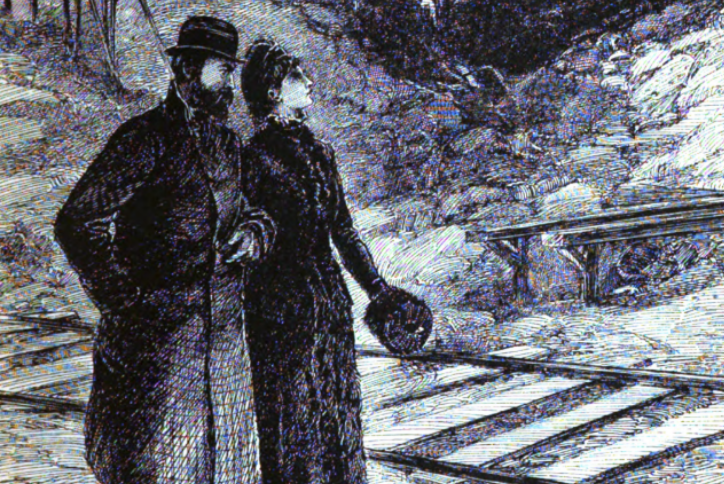
I wrapped the cardboard and the broken glassware in my handkerchief, and started down the tote road home. It was growing late, only half an hour to supper-time; and I was glad, as I turned into the main road, to observe, emerging from a cloud of dust behind me, the familiar countenance of the mine pony, and in his wake the superintendent seated beside my friend Louise Norther.
“Have a lift, Baird?” said he, pulling up beside me.
I climbed into the buggy, and perched precariously between them on the edge of the seat.
“Been out exploring, Mr. Baird?” asked Miss Norther, with an amused glance at the rents in my handkerchief.
“Why, yes,” I replied, thrusting the obtrusive object into my pocket.
“Traced that manganese at last, Baird?” queried the superintendent.
“No; no outcrop this time,” said I; and I clutched the buggy-top as we jerked over a fallen birch-tree. “Just some historical glassware I’ve found.”
“Oh, do tell me about it!” cried my companion on the left. “What was it for?”
“For Z. Z., I answered, oracularly.
Miss Norther looked up with accelerated interest. “Why, what do you mean?”
“Oh, nothing,” I said. “I’ll tell you about it some time.”
“Better stick to the outcrop,” murmured Forder, flicking a graff of the pony’s flank with his whip.
Louise Norther relapsed into contemplative mood, and so we reached Mrs. Finnigan’s boarding-house. After I had jumped from the buggy, the girl leaned out, and giving me her hand:
“You haven’t been up for quite a while, Mr. Baird,” she said. “I wish you would”—and, by way of afterthought, “you can tell me about Z. Z., you know.”
Late in the fall of that year I received a letter from the secretary of the Pennekawba Company, requesting me to visit the mine, which had by this time been placed in good working order, and to take for analysis a thorough sampling of the ore in sight, as well as to examine the lean formation which several crosscuts had previously penetrated. I borrowed Forder’s horse, and drove out to the mine. The snow along the trail was once more fresh with footprints; white smoke from the boilers wreathed the neighboring trees; and the clinking of the blacksmith’s anvil rang strangely on my ear as I approached. I went below ground at once.

It was about a quarter to six before I had finished my sampling; then, throwing the bags over my shoulder, I picked my way as rapidly as I could toward B shaft. But I had wandered far in my investigation, and what with the fallen caps and posts that blocked the entries, what with my own unfamiliarity with stopes across which my lamp threw but a reluctant glimmer, and my anxiety to avoid no thoroughfares of crosscuts, and treacherous winzes, my progress was anything but rapid; and I reached the shaft just in time to see the skip rising above me with the few miners who had worked as late as I.
I threw my samples on an ore car, and was waiting, in vexation of spirit, for the skip to be lowered, when I remarked at one side of the shaft what appeared to be the entry to a hitherto unexplored crosscut. I thought I might as well give the place a look, and if necessary take a sampling; so, selecting an empty bag, and knocking my lamp on a timber to revive the light, I crawled over the fallen rock which blocked the opening. There was something unusual about the place. A drill stuck in the breast at the farther end, close by lay a striking-hammer as if dropped in haste, and to one side was a stick of powder with the fuse attached for blasting. I resolved to make inquiry. I turned to go, and was clambering over the rock once more, when I noticed above me a beam that supported the back of the crosscut, in an evidently weak spot. Folded over the beam was a miner’s oil-skin coat.
I reached up and laid my hand on the dripping oil-skin; from under it fell the fragments of a close blue jacket such as miners wear, and splashed into the water at my feet. I turned the garment curiously with the toe of my boot. “Here it must be that the three miners were working, who were caught and crushed in the cave-in of 1873. Their bodies,” I soliloquized, “are hidden, perchance, beneath that very rock-pile over which I have climbed. And this poor jacket no hand has touched since its owner folded it away, and turned to smite the drill, on that fatal spring morning.”
I stooped, picked up the fragments more reverently, and replaced them on the beam. A something in the pocket arrested my hand, and I drew forth what seemed a note-book, furred and moldy from dampness. I separated the soft leaves; the writing was in German, well nigh illegible. One cover was gone from the book. Where had I seen something like this before? It flashed across my mind: “Gott sei mir Sünder gnädig.” Those dainty, almost feminine characters were the same—no doubt about that. The man who scribbled that “God be merciful to me a sinner,” on the cover of his note-book, had got a strange answer to his prayer. Yes, that was the name, “Zschorer.” Some explanation of that—my lamp flickered, flared up, flickered again, and went out.
CHAPTER II – DECIPHERING THE OLD DIARY
The darkness closed about me, pressing like a hand on my straining eyeballs. I started, stumbling toward the entry; brought up sharply against the side of the crosscut, felt my way a few steps, and sat down on the rock to await what fortune might send me. An eternal hour I sat there, listening to the drops as they plashed around me. At last I heard a hoarse call in the entry, and caught the glimmer of a lamp along the drift. “O-i! Ba-a-rd!”
“Ho-o-o-y! aho-o-oy, Baird! where you to?”
I sprang from the pile of rock on which I had been sitting, and stumbled into the entry. The pit-boss took the flaming oil lamp from his hat as I approached, and, holding his hand behind it as a reflector, examined me curiously, glancing from my face to the wet papers in my hand.
“Eh, boy? What’s a matter of ee? Lamp out? Looks as scairt as if ee’d seed a ghost. We was a-lookin’ for ee on surface, and couldn’t find ee nohow, till Cap’n Jim he sent me down to see if ee wasn’t somewheres below. What you b’long doin’ of?”
“Oh, I’m all right, Mattie,” said I, as I followed him toward the shaft. “I was looking over some of my notes, and forgot ’twas getting late, till my oil gave out; and then I didn’t like to try the entry without a light: so I thought I’d wait here till the night shift came down. Come on, Mat, ring six bells.”
I placed my papers in my pocket, stepped on the bail of the skip, clasped the rope with one hand above my head, and made way for the pit-boss beside me. Six monotonous clanks of the signal: the rope throbbed and quivered at the grip of the hoisting-drum, and we rose steadily past dripping timbers and ladder ways, past grim entries whence noisily insistent engines gulped and gurgled, till the air grew crisp and dry, and we stepped out of the shadow of the shaft-house into the light of the electric lamp swinging cold above us in the breeze.

“All right, Mat; tell Jim I’ll see him in the morning,” and I hurried over the snow toward the dry-house. My clothes stiffened like plate armor at the touch of the keen wind, and crackled as I brushed up the steps and plunged inside.
That night when I reached my room I dried the leaves and separated them. Placing them severally between glass plates, I was able to preserve their papers while I deciphered the characters thereon. As I have said, the writing was rather faint; but I found as I became familiar with the German abbreviations that the task became more easy. I was but a poor German scholar, having forgotten nearly all I had learned in college; but, by the aid of a grammar and dictionary which I borrowed from my chum, I was able to make sure though slow progress. At first I was several times on the point of taking Buchanan into my confidence; but, as I advanced in the story, I was so much absorbed, both by the singularity of the narrative and the remarkable scientific revelations it contained, that I determined to keep it to myself. I had but little time to work on the translation, except in the evenings, and then I could use only those which Buchanan spent on the mine, calling on Louise Norther. Louise had not been long governess to the superintendent’s children, but she seemed to have had time to capture Buchanan’s fancy.
For the style of my translation of Zschorer’s papers I can not say so much as I should wish; but I have tried to make it literal.
On the first page occurs twice the name Giessen, and once the date Feb. 24ᵗʰ, 1870. The only other decipherable words are—”halte einen Affen gekauft.” What the author should want of an ape I could not imagine. I passed to the next page. Here occurs the statement, “He bound a bear upon me.” I began to formulate the writer as the proprietor of a traveling menagerie; but my chum, who has been a student in Germany, later explained to me my mistake. On page 3 are successive dates—February 26ᵗʰ, 27ᵗʰ, 28ᵗʰ—and occasional notes from lectures by Professor Eckhardt. There are also memoranda of clinical lectures delivered by Seitz. My friend Buchanan happened to have among his relics of Germany a general University Catalogue of the year 1870-71. The announcement for Giessen gives Seitz and Eckhardt as professors in the University. A few pages farther on the writer seems to have been experimenting on his own account, as is evident from the following entries selected at random. They are the most easily decipherable of some forty-five of the kind:
“März, d. 17ᵗᵉⁿ. Keeping subject at 98° half an hour after extraction; re-injection, followed by strong galvanic excitation, caused resumption of circulation.
“März, d. 20ᵗᵉⁿ. Provost was right, defibrinated blood is safest; but death follows transfusion of blood, defibrinated or not, from animals of a different species. See Brown-Séquard, § 196. Witness my experiment (note-book II., page 10): ‘Calf’s blood upon a dog,’ et sequitur.”
Then, after two or three blank leaves, come some twenty pages of fragmentary notes, dated at intervals from May 10ᵗʰ, 1872, to January 8ᵗʰ, 1873. These indicate a decided change of scene: short sojournings in New York, board-bills paid at hotels in that city, and in various parts of Pennsylvania; records of wages received in the Lehigh coal valley; in Bradford, Pennsylvania; in Calumet and other mining towns in Houghton County, Michigan. The diary, however, of each leg of the journey invariably ends with the words, “Keine Ruhe. Heran!”
Finally, from the Pennekawba mine, Menominee County, Michigan, comes a consecutive narrative, beginning January 25ᵗʰ, 1873.
CHAPTER III – THE MEMORANDA OF Z. Z.
These were Zwingli Zschorer’s memoranda, as I translated them:
“The birds love me at any rate, and so do the dogs,—and with them I can live. For dogs never question, they simply accept. One night last week, as I lay in my bunk, came that hound, whining at my door. I let her in, a weary, foot-sore, hungry-eyed hound; lost by some hunting party in the unfamiliar wilderness. She looked in my face with sad, soft eyes; I licked my hand, and lay down by the stove. I bound up her feet, where the sharp snow-crust had torn them; threw a blanket for her by the fire; and gave her what was left of my supper. She rubbed her head on my knee, whimpered like a lost child, and forgot her troubles as she curled up by the warmth of my stove.

“Strange! A year ago I should indeed have welcomed that dog; but with how different a motive! How carefully I should have anesthetized her, trepanned her; how delicately used the scalpel and the forceps, how nicely traced the quivering muscle to the insertion; and with what precision I should have regulated the temperature which the brute now seeks to regulate for herself!
“Sitting here to-night, my miner’s lamp stuck into the logs behind me, I am conscious of that dog, nor of my shadow unsteadily darkening the wall; I am conscious of myself. How would it look to the eyes of an impartial scientist? I will put my story down, black on white. I will be impartial, I will judge myself.
“Two years ago, I was a Privat-Docent at Giessen,—No. 41, Nord-Anlage. My house stood in a court, just by the intersection of the Anlage with the Marburger Strasse that ran round the old town. In the same court and just opposite me lived the Herr Oberst von Porensky, a dear friend, although he was unable to appreciate my chemical Steckenpferde—hobby-horses—as he used to call them. The same large garden, with its arbor for afternoon coffee, and the same outer gate sufficed for us. As you mounted the house-steps and entered the doorway (to the right of which was fastened a plate that announced me as a ‘Member of the Society for the Prevention of Itinerant Beggary’)—how well I remember the day in the day of plenty I put up that warning against outcasts!—as you entered the hallway, to the left was my laboratory. Beside the window that faced the Anlage were the cells for my galvanic battery. Before the window opening upon the court stood a long bench, at one end of which, between the windows, was a trough surrounded by hot-water pipes (I used to call it ‘the cradle’); and attached to each end of this were the electrodes of the battery. At the other extremity of the bench stood my case of reagents, and by it a few reference-books—and this note-book. The bench I employed as a dissecting-table. By stairs from the first floor, and also by steps from the court, I had access to the cellar in which were supplies of the more common re-agents. My more delicate microscopical instruments I kept in the large room in the third story. Here, also, was my sleeping room. The second floor was unfurnished, save a tiny library, and a little chamber at the back of what might have been the old nursery, in which slept my little niece and ward, Babette. She was the daughter of my only sister, who had married a young French-Alsatian lieutenant. A man of spirit was Franz. He was one of the cuirassiers who fell in the battle of Wörth, during the last desperate charge of the French upon Froeschwiller. My sister gave herself up to the nursing of the wounded in Metz, caught hospital fever, and died not many weeks after her husband. Babette, then three or four years old, was left in my charge. She had golden hair.
“I have even now paused to look over a few notes of the experiments that I made with reference to the subject that absorbed my attention during the last years of my life in Giessen. For from the time of my habilitation as Privat-Docent at the University, I had devoted my leisure hours to the perfection of my theory touching the transfusion of blood. Of course, the experiments of Denys and Emmert, of Blundell, of Provost and Dumas, had gone far to prove that by this means the vital forces might be restored. Brown-Séquard’s experiment, however, in which blood was passed from a living dog into the carotid of a dog just dead from peritonitis, seemed to me conclusive. For the animal was so far recovered as to raise himself to his feet, wag his tail, and so remain for twenty minutes, when the transfusion was repeated, and shortly afterward did he for a second time die. And it was evident to me that this second death had ensued because the simple injection of healthy blood into a diseased subject, although it had in proportion decreased the poisonous decomposition-products existing in the animal, had by no means removed them.
“In the course of my studies, accordingly, I was guided by the conception that before re-injecting healthy blood, I should first remove from the subject the vitiated blood entirely, leaving no toxic principles in the system to cause subsequent relapse. Moreover, I was this time endeavoring to isolate from the Eucalyptus a new alkaloid, by using which I hoped to remove all decomposition-products from the blood. And if by this re-agent I might expel the disease-germs, I should be able to re-fuse a perfectly healthy, bright, arterial fluid formed from the previously extracted diseased blood, and should thereby have solved the problem of permanent resuscitation from death.
“After eighteen months of unremitting labor—during which time my bills with Merck of Darmstadt and Schuchardt of Görlitz had swallowed nearly every penny of my salary—on the 8ᵗʰ of June, 1871, I perfected the isolation of my new alkaloid. From the peculiar medical qualities of its alcoholic solution I designated it chlorine.
Little did my good friend, the Herr Oberst, imagine, while he ridiculed my extravagance in chemicals, the momentous character of the secret that none but I and my dogs knew.”
CHAPTER IV – THE PHILANTHROPIST
(The Journal continued)
“One evening as I sat reading in the library that looks over the garden, Babette climbed upon my knee, and bade me put aside that poky book (dah dumme Ding), and listen to her.
“Liebch Onkelchen,” she began, “where didst thou put that ugly white Mops that thou broughtest in the other day? He wasn’t half so pretty as my dog Max. What dost thou with so many ugly dogs? Hast thou them dearer than the Max? Poor Max; he sat down with me yesterday his nose on his back; only just pushed his nose right into my face when I asked him what was the matter. And his eyes looked so drollig. Dost thou know?—I think he is sick, Onkel!’ And she gave a mournful little jump on my knee and clasped her arms entreatingly about my neck.
“I put by dah dumme Ding, and, pressing her cheek to mine, said: ‘And what wilt thou that I shall do, Babette?’
“Why, Onkel, thou madest the dear Herr Oberst stand up when he was sick, and thou didst make die Tante Amalie, so that she was able, once more, to go to the God’s Services, and be, oh! so pious; and go to all the Christmas-trees for the Christ-children, and be happy; and Fräulein Gustel’s gumboil; and Grete Schlosser—and—and—canst thou not make Max so that he shan’t sit down when I climb on his back?
“My little Babette,” said I; “sometimes I can make sick people to be healthy again; and I hope that the time may come when I shall be able to make everybody well and happy.”
“Ach, wie lieb, wie goldig!” she cried. And then she prattled on: “Why will people get sick, Onkel? I never get sick—I don’t see why they should. And the Mamma, also, was sick when M. le Curé stood by her bed there in Metz. And what made Mamma go away, Onkel Zwingchen?’
“Babette,” answered I, holding up her little warm hand to the lamp, “look, straighten out thy fingers and press them together—so! Now, tell me what dost thou see?’
“Oh, how pretty!” she cried, as the light filtered through her little pink fingers.
“Well,” said I, “when people die—”
“Ach!” interrupted the child, “I remember. La jolie Maman—her hand was so white—comme la neige—white!”
“Yes,” said I, “when people die, the life leaves them and they are white.”
“Then, it is the pink color that is the life, Onkel?
“Zwar, Babette; I think thou art a very wise little girl.’ Yes, continued I to myself, “all life is color, and color is all that is beautiful in life.”
“A few days afterward came Babette running into the room in great excitement. ‘Onkel! the life, the life, the life is gone out of the Max; Onkel! he chokes—the Max can’t breathe—he is all stiff, and then he shivers. Oh! canst thou not make him well again?’
“I took the dog to my laboratory, and recognizing that, unless extreme measures were taken, the brute would die, I resolved that the first philanthropic test of my new theory should be for Babette’s benefit.
“I laid the dog in the hot-air bath, and subjected him to anesthesia. After opening the carotid, and collecting the blood in a very large and squat glass beaker which I had ordered specially for such purpose, I added two and a half cubic centimeters of the solution of chlorine. As I did so I cautiously agitated the blood with a platinum-wire brush. On the instant there rose to the surface the yellowish film that I had awaited; it contained, as I knew, the germs and products that had vitiated the system. This serum I removed and, by means of an elaborate re-fusion apparatus, which I shall not now describe, I re-injected the arterial fluid. Having closed the aperture on the carotid, I connected the electrodes of a twelve-cell interrupted current, and was gratified by the immediate and complete resuscitation of the animal. The operation had lasted exactly twenty-three minutes. The interval during which the animal lay, to all appearance, lifeless was fourteen minutes and eleven seconds.
“I allowed the dog two days for rest, carefully attending to his food meanwhile, and on the third day restored him to Babette. With great joy she leaped up and down, clapping her hands together; and I, marking the joy of the little girl over her dumb companion, could not but reflect with emotion upon the power that rested with me, the power, perhaps, to give back to a mother the child of whose life she had despaired—like Elisha, to restore to the Shunamite the son that sat on her knees till noon, and died.”
CHAPTER V – BABETTE’S FATAL FEVER
(The Journal continued)
“I made several attempts to secure from the Clinical Hospital a patient whose hopeless condition might warrant an experiment of the extreme nature I have described; but I could not by honorable means at the same time a suitable subject and secure the requisite privacy. My impatience increased with disappointment. I secluded myself entirely from my colleagues and the assistants in the School of Medicine: the consciousness of the revolutionizing nature of my discovery forced me to regard them as representatives of a false and obsolescent era. I haunted the parade-ground by the Alte Casern; and, watching the drillpflichtige soldiers drill I gloried in the fancy that, were my discovery recognized, even war should lose its terrors; I threaded the crowded Gassen, and marked the peasant maids as they poured, sodden-faced and weary, out of the stifling tobacco factories; marked the brutalized crones, with parchment-wrinkled brows and hulking gait, that followed;—all on their way to the narrow cottages in Wieseck and Gross-Linden, and to their narrow homes beneath the ground;—and I was conscious of my power to make again ruddy those leaden cheeks, and elastic those springless feet. Restlessly through the evening I stalked the linden alley around the moat. The children called me ‘The Haunter of the Moat,’ a schworzert. At last I wrote to the governor of the jail in Darmstadt, informing him of the momentous nature of my theory, and requesting his permission to experiment, in the interests of scientific research, on some criminal condemned to death. I instanced the philanthropic example in this respect of the lately fallen Napoleon, the experiments made with his permission by the Academy upon La Farge, Michel, and Le Blanc; I besought him in the interests of humanity to grant me the person of Nicolaus Fleischmann, the recently condemned wife-murderer: promising to surrender myself to justice in case I did not restore the criminal to that life which justice was so soon to terminate.
“In vain—I was refused and laughed at. I mastered, as best I could, my disappointment, and buoyed myself with the hope that…
[The succeeding two pages I am unable to decipher, the ink is washed out. Page 46 commences with the words, “in einem anschrecken Fieber.”—Baird.]
” in a hectic fever. I had been sitting by her bedside for two days past. I had consulted with Herr Doctor von Norden, in whose judgment I had the greatest confidence; and I now perceived that the case was abnormal. Excessive and persistent nausea seemed to have sealed her life. The child, continually moaning, tossed feverishly from side to side. I held one little flaccid hand in mine, feeling occasionally the pulse, which had risen to one hundred and thirty. In order the more easily to apply the cooling lotions, I had gathered up her hair behind her upon the pillow. I should have cropped it, but I could not bring myself to do so. It was her pride.
“I had sent the nurse to her bed for the night, saying that I myself would administer the medicines at the prescribed intervals. By my side was a little table with phials, bandages, and so forth, upon it; I laid beside them my watch, to hold me in mind that at 11:30 a cooling draught was to be given.
“Gazing at Babette, and occasionally at the fire, I lived over again the hopes and disappointments of the last few months. I thought that I was down stairs in my laboratory. Experiment after experiment passed in bewildering succession before my mind. Now one clinical subject, now another, lay before me. This moment, Max; that, the white dog I had brought from the officer of Hussars, was stretched in ‘the cradle.’

“I had opened the carotid, and was agitating anxiously the blood as it flowed into the beaker; I turned my eyes to look for the flask behind me; the protruding head of Max was replaced by the coarse, unshaven features of the wife-murderer. The serum was rising rapidly to the surface, and as rapidly as it gathered I removed it. The tall receiver glowed with bright scarlet; I re-injected it, not into the criminal’s thick neck, but into the throat of Babette. And there she lay before me, her cheeks flushing with the return of life; while by the prostrate form barked her dog.
“Gott im Himmel!” cried I, “have I slept?” Max had put both his paws on my arm, and was thrusting his nose into my face, whining as he did so, and uttering short barks as if to attract my attention to Babette. Glancing at my watch, I saw that it was after three o’clock. I sprang to her bedside; Babette lay in a state of coma; her hands were cold; she had passed the crisis while I slept, and she was sinking rapidly. I drank a glass of cold water to steady my nerves; gathered the child with the bed-clothes into my arms, and carried her to my laboratory.”
(To be continued.)