Something unaccountable had happened. A hand, a real live hand, in a long lace mitten that allowed the tapering white fingers with their pink tips to show, reached out of the surrounding haze!
To say that I was astonished is to describe in very mild terms the dazed state in which I sat and stared. Left alone in my studio, I had been examining some new treasures-trove in the shape of small household articles, mementos of the home life of last century, which it had been my good fortune to rescue from junk and attic rubbish.
From my earliest boyhood, ancient wearing apparel, old household and kitchen utensils, and antique furniture, have appealed to me with peculiar force, telling facts and relating incidents in such a plain, homely, but graphic manner of the every-day life of our ancestors, that I look upon them more as text-books than as curiosities; for it is only by the light of truth reflected from these objects that we are enabled to brush away the romance that tinges the most ordinary facts, or pierce the rose-hued atmosphere of fiction with which the perspective of years surrounds the commonest objects of those remote times.
My antique frying-pans, toasters, and waffle-irons all have very long handles, the andirons of the same date rear their massive brass heads several feet above their strong, wrought-iron cross-bars.
How plainly these things tell us of the great log fires that roared in their ample fire-places in the brave old days of our great-grandsires! How the reflected flames must have glistened in the polished brass knobs on the andirons, and cast a warm glow on the powdered wigs of courtly dames, sparkled on the hilts of young gallants’ swords, and flushed the pretty faces of maids in their finery of stiff, pointed waists and rich flowered brocades!
I had been gazing especially, with a gratified, satisfied sense of ownership, at what I considered the gem of my find, an old-fashioned foot-stove.

This is not the ordinary tin box such as one finds among the carefully preserved relics of any well-cared-for colonial homestead. It is a foot-stove of more than ordinary beauty of form and make. The square box that forms the stove proper is of iron, hammered by hand into thin sheets, the top and sides of which are perforated with small holes arranged in complicated and intricate designs, while the framework which holds the box is made of quaintly carved mahogany. The door forms one side of the stove, and it stood open, showing within the metal cup that still holds the ashes of coals which had glowed and burned over a hundred years ago.
I observed the top cross-pieces of the wooden frame, worn in their middle to thin strips by the generations of feet that warmed their toes over the hot embers.

You know, when you look continuously and intently at one object for a long time, all your surroundings will become misty, indistinct, and finally disappear. That was the way with the old foot-stove as I gazed at it.
Down a hundred feet or more below me, Broadway’s rumbling, bustling tide was beginning to ebb, the orange-colored gas jets had commenced to glimmer, and the purplish glare of the fierce electric lights made sputtering nebulae in the misty rain. But this I seemed to be aware of through an interior sense, for all my powers of physical sight were occupied in watching a most wonderful occurrence. A hand had reached out of the haze surrounding my foot-stove and taken the metal cup from the open door and vanished.
I can scarcely expect my readers to believe this, and I hardly believed the evidence of my own eyes, but there was my foot-stove empty! A circular mark in the dust covering the rusty iron floor of the stove alone bore witness of the recent presence of the metal cup.
I sat and stared blankly until aroused by the presence of the same beautiful, delicate feminine hand, which replaced the iron cup in the stove, closed and latched the door, and melted away.

Thin threads of blue smoke streamed through the perforations of the iron box like incense, and I was conscious of the odor of burning wood, that awakened memories of an old Kentucky log house familiar to my boyhood; but the house was forgotten when I saw materialized from the cloudy haze a foot—oh, such a dainty foot!
The quaint red silken shoe that incased this new visitor was latched over the instep with a silver buckle, and the shoe had the highest of high heels. The slender ankle, with its silken hose, that faded away in the surrounding mists, modestly hidden by the filmy lace of an overhanging skirt, was as delicate as the fairy foot in its quaintly shaped shoe, that now rested on the top of the well-worn cross-piece of the ancient foot-warmer.
There were two feet, as I could plainly see, side by side, absorbing the genial heat that filtered through the perforations from the glowing coals inside the box; but they apparently remained only a sufficient time to assure their owner that the coals inside were warm and bright; then they were gone, and I heard, or thought I heard, the rustling of a stiff gown and skirts.
The hand was now again visible, this time covered with a red woolen mitten, and, grasping the handle of my foot-stove, it lifted it from the floor and moved off.
But all these unaccountable and wonderful occurrences were not sufficiently startling to blind me to the fact that my much-prized antique was about to be taken from me.

It was not my desire to break the continuity of such wonderful occurrences by any rash act; but the loss of my treasure was not to be contemplated, and even the knowledge that it was in the possession of such fascinating hands and feet did not prevent me from hastily rising to follow it.
My memory fails to recall how it was we reached the ground without descending the long flight of stairs in the building. However, I was presently conscious of walking over uneven and unfamiliar pavements totally different from Broadway.
Right in front, and but a short distance ahead of me, tripped the red silken shoes, their high wooden heels tinkling over the frozen ground. Presently my attention was arrested and my wonder increased by meeting a pair of yellow-topped boots, that I at once recognized as a pair that I had left hanging, along with some buckskin trousers, upon my wall.
I knew them at a glance, and their identification was complete when I saw the new heels, which I had put on them, and the tear in the top of one made by the struggles of a fat model in his frantic efforts to pull the boot-leg over his bulky calf. (The leather in these ancient foot-coverings is so dry and brittle from age that unless great care is used it will tear like paper.)
I have always regarded these old boots with a feeling akin to awe, imagining that they must have been worn by some powdered and buckled hero like the “old-fashioned colonel” who “galloped through the white, infernal powder cloud”; but, if they had been upon the feet of a country bumpkin, they could scarcely have appeared to a worse advantage than they did as they hesitated and halted beside the little red shoes.
With toes turned in, the boots shuffled uneasily about, almost tripping over each other in their embarrassment.
There is a witchery about a beautiful woman that envelops her like a mantle, reaching and covering even her feet. It is, in fact, as if she were surrounded by a peculiar atmosphere, which not only obscures or hides all defects of mind or body, but, at the same instant, brings into greater prominence all her exquisite loveliness.
It was probably a perception of this that made the boots so self-conscious. As for the high-heeled shoes, they behaved in a most coquettish manner, which apparently only tended to heighten rather than impair their charm.
However that may be, the rarest old costume in America could not have tempted me to stand in those old boots!
The greeting over, the two pair moved off together, and I followed after them, having now a double interest. A pair of boots and a foot-stove, properties of mine, were at hazard. True, the boots are old and worn—I have no duplicate of the other, or, as a shoemaker would say, they are not “rights and lefts.” The toes are bluntly pointed and stiff, but I know of no other boots of the same make and date, and that is the reason they are dear to me.
They did not appear to be in the least dear to those little reckless feet in the red, buckled shoes, and I made a mental note, as they tripped carelessly on, how the high heels prevented the small feet from touching anything but their toes to the earth; while the great, broad-soled, pointed-toed, square-heeled boots moved along humbly and awkwardly, slap! slap! beside their tiny companions.
The amount of emotion and thought that can be expressed by feet was a revelation to me. Such graphic expression of not only character, but incident and feeling as well, gave an additional interest to this strange adventure, and the interest grew to excitement when I saw a pair of Wellington boots come walking briskly up! I knew them—knew them well, for I had often tried to induce their owner to part with them. They belonged to a studio on Fourteenth Street.
As the new-comers came in sight, my boots looked mad. One would think it impossible for a pair of boots to show anger; but the manner in which my old Continentals set themselves squarely upon the ground, the bluntly-pointed toes turned out in a dignified, yet defiant manner, was very expressive, and as unmistakable as a clinched fist or a corrugated brow.

A moment’s hesitation, and the little red shoes ran ahead to meet the Wellingtons, and there they stood, side by side, the new-comers a great deal closer to the dainty silken toes than my poor boots had dared to come.

Intuitively I began to take sides with my property; my sympathies were all with the Continentals, and I was aware of an undignified prejudice and jealousy toward an old pair of Wellington boots!
As the pedestrians started on their walk again, the feminine shoes guarded by the Continentals and Wellingtons on either side, I followed, fully determined to pursue the adventure to an end.
The foot-path that we traveled was strewn with dead leaves and edged with grass. No thought of where we were disturbed me, but I was impressed with the feeling that the Wellington boots were trying to monopolize the attention of the red shoes, and either ignoring my Continentals entirely, or acknowledging their presence only by slighting or flippant remarks; and my surmises were in a measure confirmed by the occasional grinding twist of a Continental heel into the frozen sod.
Presently we turned into a well-traveled road, where there seemed to be many feet, all walking in the same direction; their destination proved to be a building, which we entered after ascending some wooden steps. A musty odor, peculiar to hymn-books and wood-work which receive an airing only once a week, proclaimed the building to be a church.
If it was cold inside the edifice, I was not reminded of it until the little, red-mittened hand placed the old foot-stove near by, and the same fascinating, red-clothed feet hopped upon it.
Close upon one side were my old Continental boots, and upon the other side the Wellingtons.
It was with ill-concealed impatience that I watched the egotistical wrinkles assumed by the impertinent up-town studio boots, and I felt my blood tingle with anger when they rested their varnished and polished toes against my old foot-stove, upon the top of which the little red shoes were perched.

For a time all three pairs of foot-gear maintained a deportment sufficiently discreet for church manners, but the way the Continentals finally kicked over a wooden footstool satisfied me that they at least were not in a receptive mood for the sermon.
Although conscious in a general way of my surroundings, my senses of hearing and of sight were focused upon the three pairs of feet, and what did not immediately affect them made no impression upon me.
I suppose the benediction was said, but I heard neither sermon, hymn, nor benediction, and only judged the services had ended by the movement of the feet.
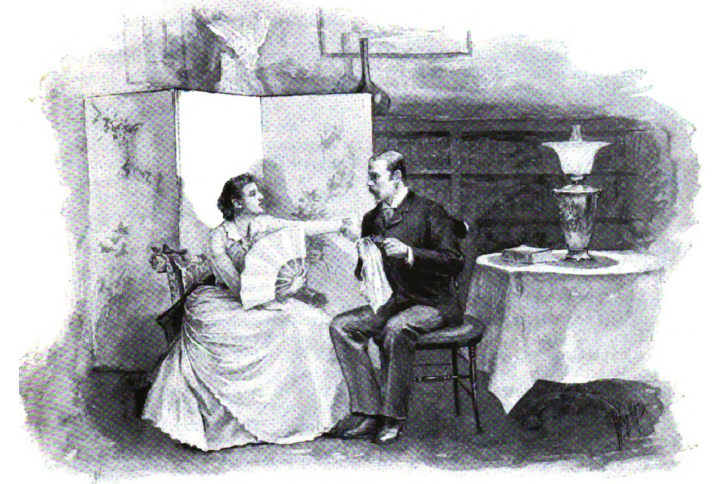
When the dainty, high-heeled shoes had descended from their perch upon the foot-warmer, two hands reached down simultaneously as if to take the stove. One was broad, muscular, and sun-burned; the other was gloved, but showed an aristocratic narrowness and length of fingers; and, notwithstanding the thick lace frill which fell partly over it from the wrist, there was nothing weak or effeminate in its appearance.
While I could not help admiring the refinement and genteel proportions of the gloved hand, I disliked it all the more for its good points. There was a momentary struggle between those two hands for the possession of my foot-stove, but it was soon evident that the brown fingers had been too quick for their rivals, and the latter retired, only to immediately reappear with a small visiting-card between the index and the second fingers.
The brown hand, as if in haste to carry the pretty foot-stove out into the aisle, hit its aristocratic comrade, and the card fell to the floor. Then the Continental boots stepped on it with a peculiar angry tread, and it seemed to me that, whatever the sermon had been about, it had not put much religion into any of those boots. For the dainty little red shoes had an air of coquettish pride at the sparks of jealous rivalry that were glancing from the boots on either side. (If you could have seen them, as I did, you would surely have said they were as expressive as countenances.) And the boots were bristling with a desire to trample on each other. In fact, only the presence of the delicate feet between them preserved peace.
Yet, as they passed out in the crowd of worshipers, they were the most interesting group of the entire throng. There were the shambling boots of aged men, aided by their stout canes, the easy gaiters of silk-clad dames, and many tiny feet of boys and girls moving in suppressed vivacity. There were reverent footsteps, as eloquent of piety as any upturned eye, and hasty paces toward the fresher atmosphere without, that spoke of tediousness in the service.

As my double trio moved in churchly procession out into the crisp air, I noticed that a number of prim masculine boots, strangers to me, halted in admiration, and several motions indicated the exchange of courtesies. It was evident that the pink shoes with buckles belonged to the belle of the town; and that made me all the more curious as to the outcome.

Once again we were walking over the frozen ground of the country road, retracing our steps, and we had proceeded quite a distance when my strange guides stopped for a moment and then separated. The red shoes tripped lightly away until they passed the base of two large stone posts, but walked more slowly as they continued up a well-kept path.
To my surprise the boots did not offer to follow, but both pairs strode briskly together off in an opposite direction.
Here was a dilemma I had not anticipated. I was morally certain the red shoes had carried off my foot-stove; but, when I thought of my Continentals disappearing in company with those Wellingtons, I decided to follow the boots, consoling myself with the thought that the stove was probably safe, and that in the ordinary and natural course of events the boots would be sure to find the silken shoes again, and I my foot-warmer.
We left the road and walked Indian file through underbrush and briars to what appeared to be a clearing in the woods. I was glad to be out of the brambles, for, knowing the fragile condition of my old boots, I greatly feared there would be nothing left of the top leather, and so interested was I in looking them over to count the damage that I at first failed to notice their odd pose. With toes pointing at right angles from each other, the boots stood planted wide apart, giving them a peculiar and I thought a somewhat dangerous look, if such a term may be used, when my attention was attracted by a clink and ring of metal, and, raising my eyes, I saw two gleaming steel blades—two long bright swords fencing in mid-air, lunging and parrying away in fine style.
My heart fairly stood still with excitement. I dreaded lest some lunge or stab might bring a pale, intense face within the circle of my vision.
It was skillful and brave work. That broad brown hand was as firm as iron, yet as supple in the wrist as a steel spring; and its long, thin, white, lace-edged antagonist was as quick and vicious as a cat’s paw.
For an instant, the only movement of the crossed swords was a nervous tremor, then, like a flash came a quick stroke and twist—up went one sword with a ringing sound glinting into the air.

“Bravo!” I was about to cry, when I was hushed by the appearance of that same soft, feminine, lace-mittened hand, much whiter now than before. It grasped the victorious blade, and closed the pretty fingers tightly over the wicked shining steel, while its trembling mate rested upon the big, broad, brown hand that still held the sword on guard. There was a moment’s pause, then the sword dropped, and two brown, sinewy hands grasped the little mittened fingers in a rapturous, uncontrollable sort of a way, which not only plainly said that they cared not to press their vantage with the sword, but that they would brave anything for the sake of holding those little lace-mittened fingers.
To make sure to whom the brown hands belonged, I cast down my eyes and saw, as I felt I would, my old Continental boots. They were now no longer awkward, but with a sturdy, manly, happy stride, they walked alongside the red-silken, high-heeled, buckled shoes; and while these looked just as pretty, just as dainty, and just as piquant as ever, they had not now any suggestion of coquetry about them.

As they moved off, I followed, until we came suddenly upon my old foot-stove, where it had been hastily dropped by the side of the path. While I looked at it, the boots and shoes passed on. I noticed that the stove door was open, and all looked dark within.
The haze around the old foot-warmer gradually melted away, and I saw reflections of the lights from the streets dancing upon the walls of my studio, and in the dusky shadow I could trace what appeared to be my old Continental boots hanging alongside the buckskin trousers. I jumped from my seat, lighted a match, and examined the old foot-stove. The cinders were still in the metal cup. I moistened my finger with my tongue, touched the cinders, but they were cold!