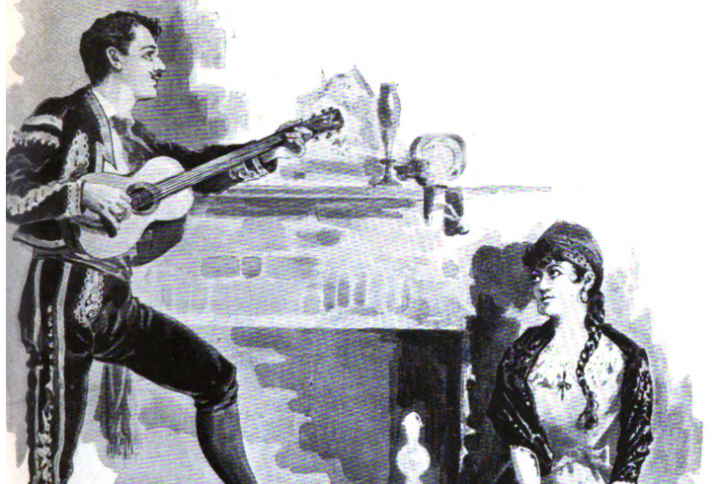
When a boy, his comrades called him Lucy. His real name was Lumous Almorin Cox. He had a round, bullet-shaped head, thin flaxen hair, small eyes of a dull blue unadorned with lashes, a fair complexion, and the figure of a Spanish water-jar. His nickname, therefore, indicated no physical graces but certain feminine qualities, which were betrayed in a timid, reticent bearing and a disinclination to join in boyish sports. At thirty, he was much the same—shy, silent, and solitary. His vocabulary was astonishingly small and monosyllabic, and when suddenly accosted, he stammered a little.
For ten years, he had been a clerk in the office of Steese & Sons. No one knew whence he came or where he lived. He was always at his desk when his fellow clerks arrived. At noon, he took from its peg the hat whose narrow brim rendered his round face so ridiculous and retired to the basement, eating his lunch on an empty box that stood just outside the engine-room. This box was known as Cox’s dinner table. The janitor never thought of removing it and even came to words with the oiler, a new arrival who, on one occasion, threw his waste into it. In the office, it is true, they sometimes laughed at him and joked at his expense; but they no longer teased him as his playmates had done when he was a boy. Now that he had become a man, it was impossible to do so without a sense of shame. It was like annoying a woman.
At five o’clock, he wiped his pen carefully, closed his books, took his hat in his hand, and said, “Good night, friends.” He had spoken these words some three hundred times a year for ten years, yet they cost him a visible effort. He waited till his hand was on the knob of the door before uttering them and disappeared so quickly that no one had ever been able to reply to them. If you have seen a young girl who, firing a gun for the first time, presses the trigger nervously, closing her eyes to all consequences, you will have an idea of the way in which this salutation was delivered.
On one occasion, through curiosity, the bookkeeper followed him. It was a shameful action, and he knew it; for in relating the next day his discovery, he felt bound to say, “Just for fun, you know—I had nothing to do—indeed, a mere accident.” It was a winter night. The air was full of snowflakes, which glittered in the glare of the lights as the wind eddies hurried them to the slime of the pavement where they were instantly obliterated. Cox had no overcoat, and his office jacket, buttoned closely about his fat figure, was drawn in tight folds above the hips in a comical manner. He hurried along the crowded sidewalk with a short, quick step, glancing now and then at some brilliantly illuminated window and finally disappeared into one of those dingy brick houses whose shutters are decorated with the sign “Board and Lodgings.” His watcher, stepping into a neighboring archway, waited patiently. After some time, the door opened, and Cox reappeared. He had changed his jacket for a long coat of black broadcloth, much worn and shiny but scrupulously clean.
Where was he going? On some gallant adventure? To some rendezvous? With the same quick step, he turned into a side street and entered a dimly lighted basement. Through the low, steaming window could be seen a few tables on a sanded floor, a counter on which were ranged some unsavory-looking dishes, and behind which a man in his shirtsleeves was frying tripe over a smoky brazier. Perceiving his customer, the man nodded and placed before him a glass of milk and a saucer of oatmeal. The clerk poured the milk, which was very blue, into the saucer and began to eat hurriedly. This performance was purely mechanical. The body requires so much food at regular intervals. “Well, then take it!” he seemed to say. From time to time, he glanced at his silver watch. Evidently, this repast was but the prelude to something of more importance, something of which he was thinking, his small eyes twinkling with anticipation and a faint smile hovering about the corners of his mouth. Having finished, he drew a five-cent piece from his pocket, paid his modest bill, and went out.
The streets were filled with cabs, and the sidewalks thronged with people. It was the hour of the pleasure-seekers. Emerging from the deserted byway, he joined this throng and passed with it under the illuminated arch of the Tremont Theater, taking his place in the file already formed before the ticket office. When his turn came, to the astonishment of the bookkeeper, this man who ate his lunch on a box in the cellar and dined on a saucer of oatmeal, drew a dollar bill from his frayed wallet and, receiving his check, passed through the gate with the nonchalance of an old theatergoer. Why not? Five cents for the pleasures of the stomach, a hundred for those of the mind—admirable division.
The house was crowded. Wyndham was playing The Private Secretary. Be it said here, however, that it mattered little to our hero who or what occupied the stage. As may be supposed, he was no art critic. Comedy or tragedy were equally acceptable to him. The essential thing was that there, on that stage, was enacted all that life from which circumstance exiled him and to which even in its humble forms timidity would forever keep him a stranger. And here, under his eyes, almost within his touch, life defiled before him. Kings, nobles, soldiers, heroes, villains, charming women spoke to him. Innocence, crime, passion, temptation, love—everything which in his own pale existence seemed but shadows were here realities. In the chair which he occupied, he truly lived; all else—the street, the office, his shabby room—was a dream. His neighbor, chatting in a low voice with her escort in full dress, little thought what tightenings of the heart, what convulsive little gasps repressed with difficulty were going on beside her. That quick cough was only a device to bring forth a large red handkerchief which had secretly conveyed away—O! how many tears!
When he went out again into the street, he carried with him all this glorious life. Hurrying homeward, falling asleep in his narrow bed, copying letters at his desk, all these people talked to him. The pretty soubrette made love to him; the heroine in peril threw herself on his breast; the villain made him dark proposals; and these scarcely audible sounds and sudden gestures, which escaped him at his desk to the great surprise of his fellow clerks, were the replies—tender, assuring, defiant as the case might be—which he made to these overtures.
On this evening, he was particularly happy. At every amusing situation, his shoulders shook with suppressed laughter. How could these people make such mistakes? He would have done very differently. Between the acts, he read laboriously the advertisements of the program or listened to the conversation about him. In this innocently surreptitious way, much of interest mingled with the monotonous strain of his existence. At his left, two gentlemen were conversing.
“Anatomically, anything is possible nowadays to the surgeon, provided only the proper antiseptic measures are taken. The air, the hands, the instruments—everything may be sterilized. This well done, a good operator has little to fear. The rest is like digging in the streets. There are pipes of all sorts—gas, water, steam, drainage—to be avoided. The operator who is sure of his anatomy knows how to do this. We have a fellow now, Jones, in the surgical ward who would be a wonder to the profession of twenty-five years ago. A man was brought in the other day, pale, emaciated—he had two weeks to live. He had swallowed his teeth. They were lodged in the esophagus about two inches above the diaphragm, and every effort to dislodge them had failed. Jones thought it all over.
“‘Look here,’ he said to him, ‘anatomically, there is no reason why I should not open your stomach, put in my hand, and take those teeth out. Such a thing has never been done, but I repeat, anatomically, there is no obstacle. In a fortnight, you will be a dead man anyway.’ Well, the fellow jumped at the idea, and today I saw him walking in the yard. He will be discharged shortly.”
“Marvelous,” said his companion.
“Yes, it is marvelous. Antiseptics have done for the operator what anesthetics have done for the patient. Take abdominal surgery, for example. The old operators did not dare to attack this cavity. Now, if we can but ensure asepsis, experience justifies daring. There was a case last month—of sarcoma—a tumor, you know. Jones removed a meter of the smaller intestine.
“‘This is of no use,’ he said, so he cut it off and joined the ends.”
“And the patient recovered?”
“Perfectly—a woman. By the sixth day, the ends were united, and on the twenty-eighth, she was discharged. You know the appendicula vermiformis?”
“No.”
“It is a little blind sac below the cecum. Its function is not known. A grape or apple seed, or even a husk of oatmeal lodging there, produces serious, often fatal, consequences. A young man—”
The bell had rung, and the rising curtain checked the conversation.
The little clerk had devoured every word. Yes, indeed, it was marvelous! Think of it! To cut open one’s stomach! To remove a meter’s length of the intestine! And that little sac, the appendicula vermiformis, how funny it was! He remembered that his mother had obliged him to remove the seeds of grapes and had forbidden him to eat those of apples. Did she know, then, of this appendicula vermiformis? But the denouement of the comedy was at hand, and he became absorbed once more in the actors.

That night, however, while undressing, the conversation he had overheard recurred to him. He regarded himself curiously as he buttoned his nightdress. So he too had this appendicula vermiformis. It was perhaps the length of these strange words which fascinated him. Lying alone in the darkness, it suddenly occurred to him that he would like to see this singular object. But how? Doubtless, it would be represented in the plates of some scientific work, a treatise on anatomy, for example. And amid the roar of the wheels, which rose from the pavement to his attic room, might have been heard these words uttered in a thin, high voice with great determination: “Capital idea! We shall see it!”
It was remarked on the following day that the little clerk, instead of descending as usual into the basement to eat his lunch, went out into the street. In an alley nearby was a bookstand where he hoped to obtain what he desired. He managed to eat a mouthful as he went and to make way with his hard-boiled egg while examining the books on the shelves. The custodian of these dilapidated volumes, quick to discern the serious purchaser, accosted him. “Was he looking for anything in particular?”
“The appendicula vermiformis,” stammered the clerk. “That is to say, have you perchance an anatomy?”
“A superb one, a first edition. A little worn perhaps, but that is nothing. The contents are intact. What is a binding, after all?”
Munching his last crust of bread, Cox turned over the leaves eagerly. “Carpenter’s Human Physiology—The Human Functions—Food and its Destination—The Digestive Processes”—ah! “A View of the Organs of Digestion”—every part numbered to correspond with the description—”No. 40 the cecum; No. 42 the appendicula vermiformis.” There it was, exactly as it had been described—a little blind sac below the cecum. And what a place for a seed to lodge in.
“It is yours for one dollar.”
“I will see about it.”
“Seventy-five cents then,” said the dealer as his customer moved away.
All the afternoon, copying so many figures, it was not strange that these two haunted him. Every invoice, every bill of lading had this fraction; every comma recalled this singular appendix to the cecum. Before closing his books, he examined his wallet. Seventy-five cents—that meant no theater again for a week—that was all.
Trudging homeward that night, he had under his arm a brown volume.
From that day, the little clerk studied this question with assiduity. He even braved the lady who presided at the desk of the Public Library, asking timidly for Surgical Reports, Manuals of Medicine, and the like. Colic, irregularity, sensitiveness to pressure in the right lumbar region, disturbed digestion, susceptibility to cold—he knew all the symptoms.
Early in the spring, a man presented himself at the surgical ward of the General Hospital and inquired for Dr. Jones. It was the little clerk. His round face had become emaciated. His legs were weak and trembled.
“What can I do for you?” asked the surgeon.
His visitor twirled his hat in his hand, speaking with difficulty. “I have an apple seed in the appendicula vermiformis.”
Jones regarded him with an astonishment with which was mingled that distrust of the practitioner for one who makes his own diagnosis.
“Nonsense,” he ejaculated.
Cox shook his head sadly. Pressed by the surgeon, he narrated his experience with a naiveté, which to another than Jones would have been heartrending: the conversation at the theater, his change of diet, at last one day by accident, without thinking, thrown off his guard, he had eaten an apple. Then colic, sensitiveness in the right iliac region—in short, the usual symptoms.
“This man is crazy,” thought Jones. Still, he ordered a bed prepared. The case was certainly interesting.
A consultation of the house surgeons was decided upon.
“The man is a monomaniac,” said Jones. “Still, something must be done. Look here! I will perform the operation—that is to say, I will pretend to. We will etherize him and show him his apple seed.”
The little clerk was delighted. He was thinking of the man who, so soon after the removal of his teeth from the esophagus, was walking in the garden. “I hope it is not too late,” he said feebly.
On the morning of the operation, Jones was dumbfounded to hear that the little clerk had died during the night.
At the autopsy, the appendicula vermiformis was found empty.