How did I get my fortune, do you ask? Well, thereby hangs a tale.
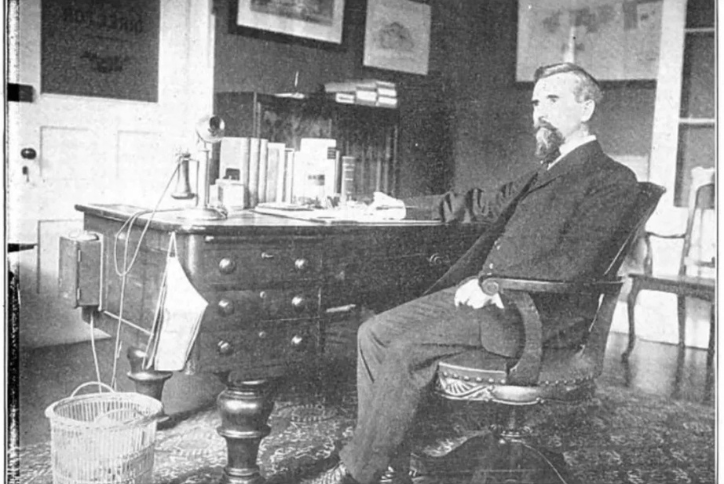
As old Jim Tolley uttered these words, he leaned back in his arm-chair and laughed until his sides shook. He was a fine old gentleman, with a bald head and a red face — not a tippler’s face, for he was quite temperate in all things; and that fresh-looking, healthy color was only indicative of outdoor exercise and generous living.
Oh, there’s no secret about it. You see, when I was a lad, I had a face as smooth and handsome as any girl’s; and many a time, just for a lark, I used to dress up in girl’s clothes and have great fun. We used to play charades at evening parties, and if there was ever a lack of girls to take the bolder parts, I was always chosen to fill the place.
I little thought, in those foolish days, that my propensity to play pranks in female attire would be the cause of my losing, and then the means of gaining, the competency and comfort I have enjoyed for a half century; but so it was.
I was just eighteen then, short in stature, as I am now. My good father must have considered me quite smart; for he often sent me on long journeys to transact business for him. Though I enjoyed fun and frolic, I had no liking for vice of any kind, and I made it a rule to be honest and true in all my dealings.
Well, on one occasion, my father sent me on the longest journey I had ever under-taken. It was to Havana, Cuba. I went by steamer from New York, and it was a most delightful trip. I completed my father’s business, and returned to Rattlesville one evening, a week earlier than I was expected.
On entering the house, I found that the family, consisting of father, mother, and sister, had gone to a dinner party at Squire Burgess’, who lived a mile or so from our place. The servants were surprised to see me, and said they had not looked for my return so soon.
I made up my mind to go to the dinner party, too; and, hastily putting on my dress suit, I started off.
Now, Mrs. Burgess, the wife of the Squire, was one of the jolliest little women that ever brightened a home. Her face was wreathed with perpetual smiles; she loved young people, and always mingled with them when she could; and as for practical jokes, why she loved them almost as much as she did her young friends — I mean innocent, practical jokes. Whenever there was a chance for fun, she was ready to lend a hand.
As I walked toward the Burgess mansion, it occurred to me that I might have some fun myself, and give much amusement to the guests at Mr. Burgess’.
I must, however, before going further with my story, tell you something about my uncle Toby Tolley. He was a rich old bachelor, grumpy, and eccentric in his manners, though quite a favorite with many. He had great likes and dislikes, and did odd things occasionally, which caused his enemies to say he was “a little off.” He was particularly cautious in his dealings with the fair sex, and people said he was a woman hater, as he had never married, and so seldom went into the society of ladies.
The only member of the opposite sex that he had ever taken kindly to was an orphan girl by the name of Bertha Snyder. She was the daughter of an old chum of Uncle Toby, who had died when the girl was a child. She had lived with an old aunt since the death of her parents, but out of love for his dead friend and real pity for the orphan, Uncle Toby clothed and educated her. She was, at the time I speak of, commencing to teach school. A pretty, charming creature! I fancy I see her now, with her rosy cheeks, blue eyes, and auburn hair. A lovelier girl it would be impossible to imagine.
As he said this, Jim Tolley’s wife, who sat knitting near the fire-place, exclaimed: “Now, Jim Tolley, you stop; you are a perfect old goose!”
“It’s the truth, my dear; it’s the truth I’m telling!” cried he; and he went on with his story:
Let me see, where was I? Oh, yes; the pretty girl! As I said, Uncle Toby was generous toward her, and some of the people of the neighborhood, who liked to tease him, spread it abroad among the gossips that the old bachelor was educating Bertha Snyder with the intention of marrying her.
I must tell you that, from the day of my birth, my parents had been given to understand by Uncle Toby that I was to be his heir, and this thought had been instilled into my mind from my earliest infancy, and it had been encouraged even by Uncle Toby himself on divers occasions. He often took me for long drives in the country, gave me instruction in the ways of the world, and did me many acts of kindness. He even went so far one time as to say that he hoped I would always be a steady, sober man, and put to a good use, and manage well, the valuable property he would leave me at his death.
But to return to the dinner party at Squire Burgess’. As Intered the beautiful grounds surrounding the mansion, I could see by the illuminations within that a large party was assembled. I had thought out a plan for my lark, and, instead of going to the principal entrance, I went to the housekeeper’s door in the rear. I was instantly recognized by the servant, who admitted me. She expressed surprise at my appearance, saying that the visitors had been talking about me at the dinner table, and hoping that I would have a prosperous voyage to Cuba and back.
“Don’t tell anyone I’m here,” I said, “but ask Mrs. Burgess if she will step into the library for a moment.”
I entered the room, in which the light had been turned low. Presently, Mrs. Burgess, genial and smiling, came toward me. As soon as she recognized me (for the servant had not told her it was I who wished to see her), she looked at me a moment, dumb with surprise, and then exclaimed:
“Why, bless us! we thought you were in Cuba! Oh, how glad I am to see you; pray, come into the drawing-room; we have such a charming party.”
“Is Uncle Toby here?” I asked.
“Oh, yes,” replied Mrs. Burgess.
“Who else?” I inquired.
“Well, there are the Wilmotts, the Lills, the Lingfords, the Musselmans, the Husons, and the minister, Mr. Day, who makes more fun than anybody else. Do come in; it will be such a surprise! Tell us all about Cuba and the curious things you saw there.”
“Wait a moment,” said I, as Mrs. Burgess was about to draw me from the room. “I want to play a little joke on Uncle Toby. Can you dress me up as a girl?”
“Oh, how delightful! Yes, of course I can,” replied the motherly dame. “Come up stairs.”
I went up into a large room containing wardrobes, from which Mrs. Burgess and her maid soon selected an outfit, from the stylish hat to the dainty shoes. When dressed, the artificial auburn curls placed around my temples, and the light veil thrown over my features to complete the deception, I looked like a beauty, and, as every one who saw me said, the very image of Bertha Snyder.
I then descended to the hall, went out at a side door, and walked around to the principal entrance, where I gave the bell a vigorous pull. According to arrangement, the servant who opened the door took me into the library, and then went to the drawing-room and announced in a clear voice, so that every one could hear:
“A young lady wishes to speak with Mr. Toby Tolley in the library.”
My mother told me afterwards what a commotion this announcement made in the drawing-room. The company made it uncomfortable for Uncle Toby by coughing significantly, “Ahem!” “Oh, dear!” “A young lady, indeed!” “Fie! Uncle Toby,” while the gentlemen indulged in such remarks as, “ Now, Uncle Toby, make a clean breast of it!” “Murder will out!” “He’s going to confess!” “ The bride elect!” “Is it one of the foolish virgins, Uncle Toby?” He said there must be some mistake, as no lady in all Rattlesville could, by any possibility, have an excuse for calling him out from company in a friend’s house. He declared that he had no business whatever with females.
Mrs. Burgess then went out of the room, ostensibly to ascertain particulars. She soon returned, saying that most certainly there was no mistake. A young lady was in the library and seemed in trouble. She begged Mr. Toby Tolley to come to her.
Very reluctantly, Uncle Toby arose from his seat, his face twitching with excitement, and his fingers nervously working a pair of spectacles that he had removed from his nose.
When he entered the library and saw me sitting on the sofa with a handkerchief at my eyes, as though I had been crying, he seemed perfectly stupefied, and, for a few moments, he did not speak. At length, he said:
“Madam, you say you wish to speak to me. May I ask whom I have the honor of addressing?”
“Oh, Toby Tolley — my own Toby!” I cried, in a falsetto voice; “how can you ask who I am?”
“I ask because I do not know you. I cannot see your face,” he replied earnestly.
“And yet you have made love to me ever so long! Oh-oh-oh! My heart! My heart will break! Oh, false and fickle Toby!” and, uttering a piercing shriek, I pretended to faint.
My cries brought Mrs. Burgess to my side, and she, though laughing inwardly, managed to say something about the inconstancy of man, and the broken hearts that that brute was responsible for. To which Uncle Toby responded by saying the young woman was either crazy or an impostor, and that he had never in his life made love to anybody.
Mrs. Burgess had, woman-like, the moment Uncle Toby left the drawing-room, whispered to several ladies the truth concerning the fair visitor, and it was, therefore, not surprising that most of the company came out into the hall and stationed themselves near the library door, to enjoy the discomfiture of poor Uncle Toby.
Feigning to recover from my fainting fit, I arose from the sofa and struck a dramatic attitude, and, wringing my hands, as if appealing to heaven to witness the truth of my words, broke forth with such disjointed sentences as these:
“To think that my darling Toby should have proved untrue! — my own darling Toby! Do not cast me aside! Pity me! Protect me! Oh!-oh! oh! Toby! Toby! Toby!What have I done?” And then I sobbed hysterically.
While I was sobbing, some ladies at the door made such remarks as, “Poor girl! Her heart is breaking!”
“Oh, fie! Uncle Toby, where is your manhood?”
“It is the old, old, story!”
“Yes; woman’s love and man’s perfidy!”
“Ladies,” cried the bewildered man, “I know nothing about this young woman. She must be mad-deranged — to act in this way!” Then, turning to me, he cried out fiercely: “How dare you commit the outrage of thrusting yourself into the house of my friend and holding me up to dishonor and ridicule? Wretch, begone! Before I have you arrested as an impostor!”
Here I drew myself up majestically, gazed at Uncle Toby a moment, pointed my finger heavenwards, and then towards him, in tragic style, as though to intimate that the heavens above would shower upon him innumerable curses. Then I fell upon the neck of Mrs. Burgess, and began to sob like a school girl.
“Don’t cry, Bertha dear,” exclaimed Mrs. Burgess, in a loud voice.
“Did you say her name was Bertha?” cried Uncle Toby, excitedly.
“Oh, dear! It really is poor Bertha!” said some one at the door.
“Yes, it must be!” said another.
“Who would have thought it?” put in a third.
“This is indeed a shocking state of affairs!” cried a solemn voice.
“Bertha? Can it be possible?” cried Uncle Toby, striking his forehead with his hands. “Yes, it is Bertha. She is mad! I will go to her aunt. Give me my hat-my hat, immediately!”
He rushed from the room, elbowed his way through the little crowd in the hall, found a hat, and speedily made his exit through the front door; and, in a few minutes, he knocked at the dwelling of Bertha Snyder’s aunt.
“Oh, dear! here’s Mr. Toby Tolley,” cried that lady, as she opened the door. “Come in Mr. Tolley. You are always welcome.”
But Uncle Toby was out of breath and very excited. Seeing that, the old lady became quite alarmed; for she had heard it rumored that he was, at times, “a little peculiar,” and the thought occurred to her that he might at last be really insane, and that, perhaps, her own safety was in jeopardy.
“Mrs. Wilkins,” cried Uncle Toby, when. able to speak, “Bertha Snyder has gone mad, and is making a scene down at Mr. Burgess’ house. I have just come from there, and I want you to go and get her away, and place her under restraint.”
“Good gracious me! Mr. Toby Tolley, what do you mean? Why, my dear sir, you must be dreaming: for she’s in the parlor yonder studying botany.”
“Studying botany!” exclaimed Uncle Toby, utterly bewildered, and stroking his bald head as though to make sure it was fast on his shoulders.
“Yes, studying botany. Come and see for yourself.”
Mrs. Wilkins, with fear and trembling, showed the man into the parlor, where, indeed, sat Bertha, with her book before her.
“Have you been in all the evening?” asked Uncle Toby, addressing Bertha.
Bertha looked at her kind benefactor with amazement, and said, “Why, Mr. Tolley, what is the matter? In all the evening? Of course, I have. I am always at home after school.”
“Then I have seen your ghost!” cried Uncle Toby.
Mrs. Wilkins, who stood behind Mr. Tolley’s chair, made a sign to Bertha by placing her forefinger on her own forehead, and then pointed to the head of Uncle Toby, as though to indicate a vacancy there. Bertha seemed to comprehend her aunt’s sign, and turned very pale.
“I have either seen your ghost or some one that is your very image in voice and appearance,” said Uncle Toby.
He then gave a long and rambling account of the occurrence at Squire Burgess’. But the story, as he told it, seemed so absurd to Mrs. Wilkins and her niece that they were confirmed in their belief in Uncle Toby’s insanity and a great dread came over them that he might become violent. Mrs. Wilkins, thinking to pacify him, began to address him by saying:
“Dear Mr. Tolley — ”
“Pray don’t ‘dear’ me, Mrs. Wilkins,” cried Uncle Toby, irritably; “I’ve had enough of that for one night. That wretched creature, spirit, or lunatic, or whatever it was, had the impudence to call me her own darling Toby. How is that for a man who never yet saw the woman he would give the snap of his finger for.” Here Uncle Toby snapped his fingers vigorously.
“I was merely going to suggest,” continued Mrs. Wilkins, “that if you were just to lie down and take a nap — “
“Take a nap!” roared Uncle Toby.
“Never! I’ll not sleep until I get at the bottom of this mysterious outrage. I’ll go back to Burgess’ at once.”
He said good night, took his hat, and went back to Mr. Burgess’ house. I must confess that when I saw him come into the drawing-room and caught his eye, I felt frightened. There was a look of desperation in his twitching face that seemed to affect all present. He stood at the door, with his back to it, as though he intended to bar the way of exit to every one, until he had redeemed his character in the eyes of the company. He began to make a speech, but had hardly finished a sentence, when every body in the room, except me, burst into laughter.
I trembled in every limb. By a sort of intuition, I became conscious that a great misfortune was about to befall me, and that, for once, I had carried my joking too far. Uncle Toby, standing there, the laughing stock of the whole company, who thought an old bachelor fair game for ridi-cule, became very angry. His brows knitted and his eyes glittered like steel.
Seeing that matters were becoming uncomfortable, Mrs. Burgess thought that the best thing to do was to explain the whole matter to Uncle Toby in the presence of the company; and this she did, pointing me out as the chief actor in the comedy, fully expecting to see Uncle Toby join in the laugh against himself. The result, however, was quite different; for, giving me a withering look, and pointing his finger straight at me, he said:
“James Tolley, you have had your fun, and I hope you have enjoyed it. Iam going to have my fun now. I shall make a new will. Ladies and gentlemen, I wish you good night.” Saying which, Uncle Toby took his leave.
Of course, everybody felt sorry for me, though a few whispered that it served me right. It was generally agreed that I had come home from Cuba just a week too soon. But I was a plucky lad, and I determined to make my own way in the world. I had already done good work in the study of law. I felt confident of my future success, and soon dismissed the matter of my disinheritance from my mind.
Of course, the joke got noised about Rattlesville, but what made me feel it most was the association of Bertha Snyder’s name with the affair. I was but slightly acquainted with her; still, I thought it right and manly to call on her, and, after making an explanation, to apologize to her. I, therefore, called one evening, and, in a timorous, bashful manner, explained the object of my visit. Whether or not I looked uncommonly foolish and ridiculous, or whether my motives in telling my story appeared too absurd, I cannot say; but certain it is that Miss Snyder burst out laughing, while I was demurely pleading for absolution; and, suddenly recognizing the absurdity of the whole thing, I blushed and began to laugh, too.
Mrs. Wilkins joined in the merriment, and spoke to me with great kindness.
“Is it true,” she asked, “that your Uncle Toby disinherited you for this foolish prank?”
“Quite true,” I replied. “I have been formally notified by him that I must not build any hopes on receiving one cent from him at his death. But that is not so distressing to me as people imagine. I am quite capable of earning my own living, being young, strong, and hopeful.”
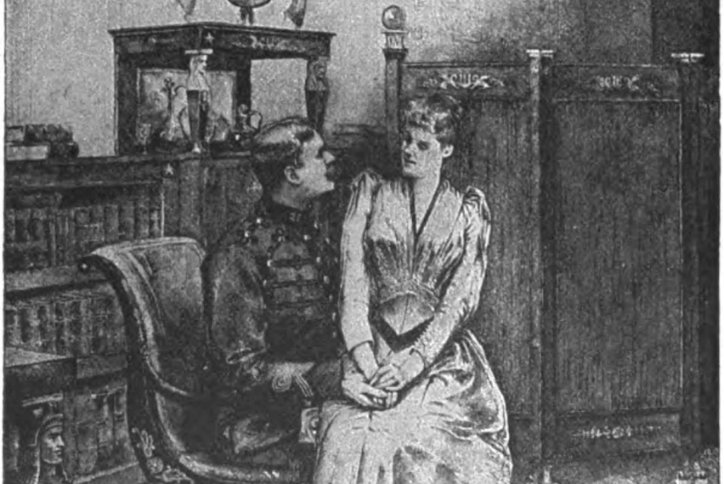
As I said this, my eyes rested on those of Bertha, who was looking at me in a dreamy, thoughtful way. That mutual gaze fixed my fate! A wonderful feeling thrilled me; a new light shone in my sky. At the same moment Bertha, as though suddenly collecting her senses, cast her eyes on the floor, while a deep blush tinged her cheeks. I knew then that she read my thoughts. I know now that they did not make her unhappy.
A remark that fell from Mrs. Wilkins as Bertha looked away from me seemed exceedingly propitious.
“You will succeed!” the aunt said, referring to my determination to earn my own living; but her reply chimed in so well with the other thought in both our minds that I was sure I knew the cause of Bertha’s blushes.
At this point in Jim Tolley’s story his good wife cried, “Jim Tolley, you are a goose!”
“I know it, mother; but I’m telling the truth,” replied he.
Well, I spent a most delightful evening with Mrs. Wilkins and her niece. I made myself as agreeable as possible. I told them stories, talked of my travels, and promised to take Miss Bertha some pressed flowers I had brought from Cuba. After that, my calls were frequent, and I never left the house without making some excuse to call again. Each visit increased my love for Bertha; and, at last, she made me happy by promising to be my wife. I had so managed matters that but few people in Rattlesville had any idea of my love affair. Bertha went daily to teach school, and I to study and work in a law office.
At this time, Uncle Toby disappeared from Rattlesville. He went to Europe, leaving his property in charge of an agent.
The old gentleman left home, no doubt, to avoid the humiliation that he would feel whenever his friends and neighbors alluded to the cruel joke that I had played on him.
In the meantime, I worked with such zeal that, at the age of twenty-one, I was admitted to the bar, and very soon after, Bertha and I were married.
We were both poor enough, heaven knows, I having only three hundred dollars in the wide world; but Aunt Wilkins was more than a mother to us; she was an angel. The good soul gave up to our use her largest room, and told us to consider her house our home as long as we wished. After we were married, we went to a quiet village by the sea to spend our honeymoon; and, although we were not rich in this world’s goods, and the future seemed uncertain, we were very happy. We made our own beautiful world, as we rambled in the woodlands and shady lanes near the sea.
A few days after our arrival, as we were sitting on the sands, watching the incoming tide, with its ever recurring wave breaks, a boy suddenly disturbed our day dreams by rushing up to us with a telegram for my wife. It read thus:
Rattlesville, Aug 2.
To Mrs. James Tolley:
Toby Tolley died suddenly yesterday. You are requested to be present at the funeral, which takes place on Thursday next.
Uriah Sharp
Counselor at Law
The message, so abrupt and unexpected, made my wife ill. I was indignant at lawyer Sharp for not having addressed his message to me, so that I might have broken gently to Bertha the distressing news of her benefactor’s death. It was very painful to have our peace and happiness so rudely interrupted:
We returned to Rattlesville as speedily as possible. Of course, we went directly to Aunt Wilkins’. She was ill, also, but was delighted to see us. The fact was, she had experienced a very severe shock, Uncle Toby having expired suddenly in her presence.
“You see,” said Aunt Wilkins, in giving us an account of the sad occurrence, “he came here to call on Bertha. He said he had just returned from Europe. When he heard of Bertha’s absence, he became suspicious and began to question me more closely, so that I became confused: I know I felt very guilty, and, noticing my embarrassment, he exclaimed:
“‘Now what’s the trouble, Mrs. Wilkins? Something has happened to Bertha!’
‘Well, sir,’ I replied, becoming quite desperate and wishing to put an end to all secrecy, ‘she’s married!’
‘Married! To whom?’ he almost shrieked.
‘James Tolley, your nephew,’ I replied.
Mr. Tolley’s face turned very red and his breathing was short and hard. He became purple, and I noticed that he tried to say something. Then he suddenly fell, face foremost, to the floor. When the doctor came, he said Mr. Tolley had died of apoplexy. Oh, dear! It was terrible!”
After laying poor uncle Toby in his last resting place, we returned to his pretty house, where were assembled a number of the Tolley family. Uriah Sharp was there, and read the will. He did it with a malignant twinkle in his eye, as he looked occasionally over his spectacles from one Tolley to another, not one of whom was left anything. The original will was read over, in which Uncle Toby had left all his property to me. Then came a clause revoking all this, stating the reason why, and leaving all of the property to Bertha Snyder, the child of his, late lamented friend and com-panion, Zachariah Snyder.
Most of the Tolley family left the house of mourning carrying their noses very high in the air, and thinking hard things about the dead bachelor. Lawyer Sharp shook hands. with me, and, winking his eye solemnly, said, “If you conduct all your cases as well as you have this one, you will soon be on the bench.”
So, you see, I not only secured the handsomest and best wife in the country, but, by her gentle grace, I now enjoy the benefits of my good Uncle’s handsome fortune, which, could he have spoken just before he died, he might, to revenge himself upon Bertha for marrying me, have given to some one else.
The old lady in the corner at this moment exclaimed: “Jim, you are an old goose!”