I.
Few people are aware of the existence of a small hostelry near Slyne Head, on the west coast of Ireland. The coal-black rocks and precipitous promontories of that desolate region render the scenery imposing; and the storms, which are frequent, form a spectacle that is nothing less than magnificent. The whole force of the Atlantic breaks against those awful cliffs, and the half-wild inhabitants of the region will tell you that, in winter, the spray is sometimes dashed three hundred feet in air. Fishing is almost the sole occupation of the natives. The nearest railway station is at Westport, thirty miles away, whence the explorer must travel either on foot or upon the dilapidated “jaunting-car” that serves as a stage, and is driven by Pat Maguire, who is also the proprietor of the inn. But explorers are as few as snowflakes in June; and for several years previous to the date of this story, Dr. Griffith Gramery had been the only visitor.
The doctor was not a comely man. He had a big, square head, covered with grizzled red hair, which stood upright; thick eyebrows hanging far down over a pair of small but extraordinarily piercing eyes; a large nose and mouth, and a broad, short chin. His head was set low down upon broad shoulders; his arms were long, but his body rather small and short. The peasants held him in superstitious awe and respect, believing him to be in league with Satan, probably because he had once or twice exercised upon them a remarkable magnetizing power that he possessed. But as all his dealings with them had been beneficent, they mingled their awe with affection. A man may be hand-in-glove with the Evil One, and yet a very good fellow at bottom.
This season, Dr. Gramery arrived, as usual, about the 1st October; but he explained to Pat Maguire that a young lady and gentleman, friends of his, would come on the 7th of the month, and would expect Pat to be at Westport railway station to drive them over. The doctor, it seems, had met Mr. and Mrs. Roger Mowbray in London during the previous season, and had sung the praises of Slyne Head so eloquently that the young couple—they were in their honeymoon—had promised to come over and spend a week there. They proved as good as their word, and on the evening of the appointed day they drove up on the jaunting-car, and were cordially welcomed at the inn door by the Doctor.
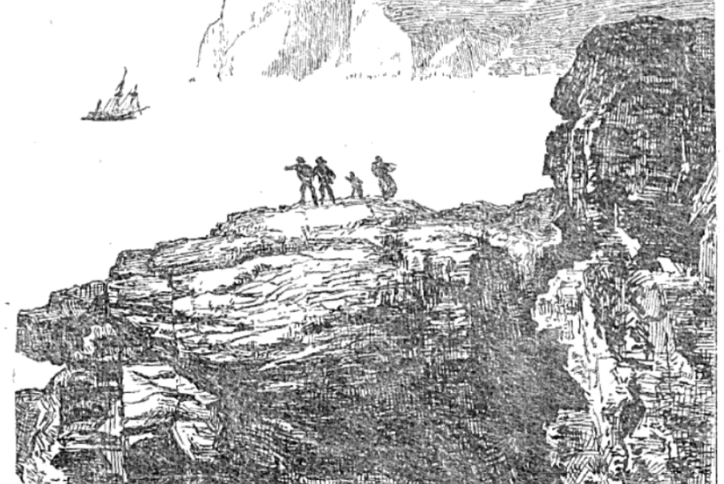
The moon was close to the full, and the air soft and mild. After supper the three friends strolled out on the cliffs; and Roger Mowbray and his wife both confessed that they had never seen so grand a sight. The rocks are full of caves, some midway in the face of inaccessible precipices, some so low down as to be covered at high-water. The coast is everywhere jagged and irregular. Slyne Head itself is a beetling pinnacle of rock, overhanging the sea, which is four hundred feet below its summit. The party made their way thither and sat down to contemplate the prospect. The ocean, rising in its vast sweep to the horizon, was luminous beneath the moon; and they could see the surf break on the ragged teeth of the rocks far below till it looked like great drifts of snow against the blackness. “How glorious and terrible it is!” exclaimed Mrs. Mowbray. “After this, I can understand and almost believe in all the legends of ghosts and hobgoblins that Ireland is famous for!”
“None but spirits of light and loveliness should become visible to you, fair lady,” said the Doctor, who had a courtly, chivalrous way with women, which, partly on account of the odd contrast with his ugliness and eccentricity, made him a favorite with the sex. “But the people hereabouts are certainly very superstitious; and, to confess the truth, I have occasionally amused myself by playing off a few jugglery tricks upon them. They take me for a magician; and it keeps them from bothering me when I want to be undisturbed. I have only to make a few cabalistic passes, and they run as if the devil were after them.”
“I recollect your alluding, in London, to your powers in that direction,” observed Roger. “You promised to give us an illustration some time. What more fitting time could there be than this?”
“Oh, I wish you would, Dr. Gramery!” exclaimed Mrs. Mowbray. “I never saw anything of that sort.”
“And I fancy your husband doubts whether anybody ever saw anything of the sort,” returned the doctor, laughing, and fixing his brilliant eyes on the young man’s face. “He is a skeptic.”
“Say an agnostic,” rejoined Roger, with a smile. “I will believe what I see.”
“If that be your only stipulation, I could easily astonish you,” the Doctor answered. “The eyesight, and all the senses, are readily deceived. Moreover, unless I am much mistaken, yours is a temperament that lends itself to such impressions. I should expect to be more successful in deceiving you than your wife; though she looks half a spirit already, while you have the thews and sinews of an athlete.”
“Well, all I can say is, I am prepared for the test,” replied Roger, still smiling, though with somewhat of an effort. The Doctor’s eyes had a singular sparkle. It was difficult to look away from them.
For a full minute, the doctor remained silent and immovable, gazing in a preoccupied manner at Roger Mowbray, who gazed back at him. Mrs. Mowbray, meanwhile, had become interested in watching the flight of a great sea-bird, which, after poising itself in air on a level with their position, suddenly swooped downward and alighted on a rock, surrounded by waves, near the foot of the cliff.
“Look at me!” abruptly cried the Doctor, in a sharp, imperious tone, springing to his feet. “I am going to jump down the precipice, and stand beside that sea-fowl. Look! Roger Mowbray, I’m off!”
Roger started up with a gasp of horror and amazement. “Good God! the man is killed!” he cried out in a wild tone. He stood gazing fearfully and breathlessly over the cliff, peering downward as if following the descent of a heavy body through the air. But after a moment he raised himself, trembling and aghast, the sweat standing on his forehead. “It’s a miracle!” he said, huskily; “such a thing was never known! He fell four hundred feet, and now there he stands at the bottom, nodding and waving his hand! Merciful Heaven! what a thing to see!”
“Why, Roger!” exclaimed his wife, half laughing and half alarmed, “how absurdly you act! Any one would think you were crazy! What are you talking about the Doctor being down the cliff, when he has not moved a foot away from you? Why, what’s the matter with you?”
Her husband paid not the slightest attention to her. He continued to stare down at the rock on which the sea-bird was seated, emitting ever and anon inarticulate ejaculations.
“He does not hear you, Mrs. Mowbray,” remarked the Doctor, speaking aside to her. “He is in what may be termed an abnormally imaginative state, in which one mistakes fancies for facts. He really believes that I jumped off the cliff and alighted on that rock; and nothing that you could say to him would change his conviction. Curious, is it not?”
“But what is the cause of it? He was never like this before!” cried she, becoming more and more alarmed. “Can nothing be done? Roger!” She laid her hand on her husband’s arm, but he moved away from her. “He doesn’t know me!” she exclaimed in terror. “Oh, what shall I do?”
“My dear Mrs. Mowbray,” interposed the Doctor, smiling comfortably in the moonlight, “give yourself no uneasiness: it is the simplest thing in the world. Your husband is partially asleep—that is all. A certain portion of his brain—that which discriminates between truth and imagination—has temporarily ceased to operate; it has been inhibited, to use the scientific term; or, if you want another phrase, your husband is in a hypnotic trance. Of course you have heard of hypnotism, and you are aware how commonly it is now practiced, and how amusing some of its manifestations are. It also has the advantage of being entirely harmless. The trance can be broken as easily as it can be induced.”
“Oh, but I don’t like Roger to be hypnotized!” she protested, still agitated. “I want him to know me and hear me! Please make him come back to me, Dr. Gramery.”
“Your word is law, my dear lady,” said the good doctor, with perfect amiability. He turned to the young man, and drawing him a little to one side, appeared to whisper something in his ear. Then he clapped his hands sharply together, and called out, “Hello, Mowbray! Here we are!”
Mowbray glanced up, yawned, passed his hand over his forehead, and then, looking at the Doctor with evident perplexity, said, “Aren’t you wet? How did you get up here again?”
II.
“You see,” said the Doctor the next morning, after they had talked and laughed a good deal over the event of the night before, “hypnotism is the real explanation of all the marvels of magic and enchantment that we read and hear about. The magician’s first act is to hypnotize the spectator, or spectators: that done, they will see—imagine they see—any miracle he may choose to suggest to them.”
“Do you mean to say,” demanded Roger, “that he can put more than one person at a time into the trance?”
“A hundred as easily as one; and perhaps a thousand more easily than a hundred. Why not? Consider the phenomena of panic—the unreasoning fear that seizes upon a multitude, though each separate man in the crowd, if alone, would have retained his presence of mind; or look at the wild enthusiasm or rage to which an eloquent orator can arouse a vast audience, though any one member of it would listen to him coldly. So I doubt not it would be easier to hypnotize a large assemblage than a single individual; and the Eastern jugglers seem to do it. You have heard of the famous Indian Basket-Trick, as it is called? There an audience of any number of persons severally and collectively witnesses a transaction that their reason assures them is preposterously impossible, at the same time that their eyesight convinces them it takes place. What is the explanation? Simply, that they are all hypnotized before the trick is performed; and then, of course, the ‘trick’ is reduced to merely inducing them to believe that something is done which is really not done at all.”
“After my experience of last night, I don’t feel like disputing anything you say, Doctor,” observed Roger Mowbray. “But I should like to know how a man can hypnotize a crowd of people, and also how they can recover from the trance without recognizing that they have been in it.”
“If the conditions be favorable, nothing is more easily performed than hypnotizing,” the Doctor replied. “Simply to fix the attention for a few moments is often sufficient; and any juggler can do that. I hypnotized you last night only by inducing you to look intently at me for sixty seconds. Then, as to your second point, the trance may be of various degrees, from light to profound. The light trance is sufficient for complete self-deception, and the transition from that to waking is so easy as not to be perceived.”
“I certainly believed I saw you jump over the cliff,” said Roger, “and after I came to, I still could hardly persuade myself that you had not done it. Rachel, here, says she spoke to me; but I didn’t hear her. But is it not rather alarming that such a power as you possess should exist?”
“Indeed, if I didn’t know the Doctor was a good man, I shouldn’t feel safe for a moment,” Rachel said.
“Luckily, I am harmless,” remarked he with a peculiar smile. “But there’s truth in your suggestion, Mr. Mowbray. Hypnotism might give terrible powers. If I had told you, last night, to jump over the cliff, you would have done it, or, if while you were still in the trance, I had commanded you to do, or to see, or not to see, a certain thing at a certain future time—say, at five o’clock this afternoon—you would have obeyed punctually at the appointed hour, without any further action on my part.”
“Dear me!” said Rachel, with a nervous laugh, “I remember you whispered something to Roger last night, before you woke him up. What did you tell him to do?”
“You said a person could be ordered ‘not to see anything,'” broke in Roger. “Do you mean that a concrete object could be rendered actually invisible to one in the hypnotic trance?”
“Certainly!” replied the Doctor. “Anything that is told to the patient, he is bound to believe. If I were to tell you that the tree yonder had been dug up and carried away, it would immediately become invisible to you; and neither your sense of touch nor any other means could persuade you that there was anything there. But I see this conversation is distressing Mrs. Mowbray: let us change it. Do you know, Mr. Mowbray, that you bear a strong resemblance to your late father?”
“I have been sometimes told so. But I was not aware that you knew him.”
“Yes, I knew him well, many years ago, when we were both about your age. Afterward, circumstances separated us. When I met you the other day in London the likeness startled me; it was as if a buried generation had come to life again. Your father’s wife was a Miss Clayton, I think?”
“Yes, that was my mother’s name.”
“Ah! I was not thinking of her as your mother. I do not trace her features in you. However, that is neither here nor there. Thinking over those old days has recalled another person to my mind—one John Felbrigger. I fancy you have never heard of him.”
“I think I remember the name,” said Roger, “but I never saw him. Unless I’m mistaken, my father and he were not good friends.”
“They were friends until, for some reason, they had a bitter quarrel, and parted. It was the general opinion that Felbrigger was in fault. He was certainly a cross-grained fellow, whereas your father was always very suave and engaging. The quarrel occurred before your father’s marriage, and the occasion of it, I think, was some affair of the heart. Naturally, Felbrigger would get worsted there!”
“What became of this Mr. Felbrigger?” inquired Rachel.
“He was a student, and after the quarrel he devoted himself to abstruse researches, and lived on the Continent, and afterward in India. He ought to have died long since, I suppose.”
“The woman in the case was not my mother, was it?” asked Roger.
“She was not the lady your father married, I think,” the Doctor replied. “It was probably some earlier affair; he was a dangerous man,” he added, laughing. “Now that I recollect, the other woman’s name was Mercy—yes, Mercy Holland. You never knew of her?”
Mowbray shook his head. “No, of course not!” said the Doctor. “And what interest have these old stories for you young people? Come, I have something to propose! What do you say to our taking our luncheon with us, and spending the day down on the rocks? There are some curious caves I want you to see; and there is a romantic legend about one of them. Shall we go?”
The others willingly consented, and they made their preparations and set out. Instead of climbing to the top of Slyne Head, as on the previous evening, they descended to the shore, above which the stupendous crags hung as if about to topple over. In a crevice of the rocks, just above high-water mark, the doctor picked up a fragment of chain with a handcuff attached to it. It was but slightly rusted, and evidently could have been left there but a short time before. Mowbray and his wife were much interested in the discovery, and speculated as to how it could have got there.
“Is there a jail anywhere in this neighborhood?” Roger inquired.
“None nearer than Galway, that I know of,” replied the Doctor. “But I believe there have been some evictions going on in this neighborhood, and this handcuff may have been put on a prisoner who escaped. He must have had an extraordinary strength to get from his fetters, however. This channel, as you see, shuts by a spring, and can be opened only by taking two hands to it. The person to whom it was attached could not unfasten it unaided. It is certainly odd that the fugitive should have shaped his course in this direction. In these thinly settled regions concealment is more difficult than it is elsewhere.”
“What a strange feeling it must be to be fastened to a chain, and know that you can’t get away,” observed Rachel, examining the steel manacle with curiosity.
“People get used to even that,” rejoined the Doctor; “and after all, we are all fettered in some way, though the links may be invisible.” He put the relic in his pocket, and they continued their journey along the beach. The way was rough and tortuous, the bowlders lying irregularly, and the pebbles of which the beach was composed offering a slippery and wearisome foothold. They were nearly an hour in going no more than a mile; but they were rewarded, at the end of their journey, by coming to a large cave, hollowed out in the seaward extremity of a promontory that formed one of the natural divisions of the beach. Its mouth was only about seven or eight feet in diameter; but inside it expanded into a chamber of fair size and height, draped with sea-weed, and pervaded by the clean, salt smell of the sea. The day had been somewhat close and oppressive, and the coolness of the cave was grateful, after their arduous walk. The interior was lighted up by the rays of the declining sun, for it was already afternoon.
Using a large flat stone as a table, they unpacked their basket, and lunched at their leisure. The Doctor was in capital spirits, and made himself highly agreeable. He related many stories of his own past life and adventures; he had traveled in all parts of the world, and had lived several years in Northern India, where he had seen strange sights. Finally, the conversation got round to the spot where they then were, and the traditions connected with it.
“And, by the by, one of the best yarns is about this very cave,” he remarked. “Many years ago a powerful noble lived near Slyne Head, and he married a young and beautiful woman. For a time, all appeared to go well; but finally the husband became suspicious of the attentions to his wife of a young man, who was visiting him. He watched, and his suspicions were confirmed. He concealed his emotions, whatever they were, and on some pretext invited his wife and the friend to this cave. He had had an iron ring fastened to the rock at the back part of the cave, with a chain attached to it. Pretending to be in sport, he induced them to let him fasten this chain around them, and then, telling them to be happy together to their hearts’ content, and replying to their shrieks and entreaties only by peals of laughter, he bade them farewell and left them. The tide was rising, and a storm was coming on. A couple of hours later the cave was submerged, and the lovers were, of course, drowned. What do you think of that legend, Mrs. Mowbray? Would you like to know what the young people said to each other, when they were left alone, and the first wave threw its spray over them?”
“It is fearful to think of,” said Rachel, with a shudder. “Was it really this very cave?”
“Undoubtedly; and if you want any further proof, the ring to which they were chained still hangs to the rock behind you. See—the sunlight has just reached it!”
Rachel turned with a start, and then all three approached the ring and examined it. It was hanging to a bolt driven into the face of the solid rock, at the furthest extremity of the cave. It was about seven inches in diameter, and appeared to be at least an inch in thickness, though it was so bearded with green seaweed and roughened with rust and limpets that an exact estimate was difficult. At all events, it looked strong enough to hold an ox, much more a pair of terrified lovers. Beneath the ring was a shallow ledge, forming a rude seat, and Rachel, who was fascinated by the picturesque horror of the thing, sat down upon it. The setting sun shone on her charming face, and gave it the semblance of a rosy blush. Her husband thought she had never looked more lovely.
The Doctor took the handcuff from his pocket, and passed the chain through the ring, fastening it by springing one of the links over another. “That will enable us to realize the situation better,” he remarked, turning to Roger with a smile, and putting the handcuff in his hand. “Imagine Mrs. Mowbray to be the beautiful wife, and you the wicked earl.”
“Shall I manacle you, Rachel?” asked her husband, playfully.
She held out her wrist at once. “Do!” she said; “I am not afraid.”
“Don’t be too sure of your nerves,” put in the Doctor; “it might give you a turn.”
“Oh, my husband will not desert me,” she replied. “Put it on, Roger.”
He slipped it on and fastened it. “There—now you are a prisoner,” said he.
“And now all you have to do is to imagine that you are to stay there until this time to-morrow,” the Doctor added, “when some fisherman, perhaps, will discover your drowned and bruised body. You are looking for the last time on yonder setting sun. Do you hear the plunging of the surf? In another hour it will be at the mouth of the cave; an hour more and it will have filled it to the roof. You will be alone, and death will come slowly and frightfully. You will struggle and strain, and tug at your fetters; the steel will cut into your flesh, but you can not break it. The cold water will creep slowly to your knees, your waist, your throat! You will scream—ah! what screams! but the rocks will echo them back, and they will die away upon the sea. You will think of the sweetness of life, of your warm and familiar home, of the love of your friends, and of your husband—and then the wave will lap over your face and gurgle into your mouth, and strangle your breath: you will be nothing but a lump of lifeless flesh, and this pleasant, luxurious world will know you no more!”
Doctor Gramery must have had a good deal of the actor’s talent; he had begun his speech lightly enough, but as he went on his voice became hoarse and incisive; he made strange gestures, and there was something terrible and ominous in his aspect. Rachel sat gazing at him with parted lips and widening eyes. As he finished she rose to her feet, and stretching out her hand to her husband, faltered: “Let me go!”
By a sudden, forcible movement the Doctor interposed himself between them.
“Five o’clock!” he exclaimed, in a stern, commanding tone.
Roger stood motionless for a few moments, while a dazed expression came over his face. The Doctor now moved to one side; the husband and wife were within a couple of paces of each other, and his eyes rested upon her. But there was a vague, vacant look in them, and presently he said, in a sluggish tone, “Where is Rachel?”
“Here I am—here I am!” she exclaimed. “Here in front of you! What ails you, Roger? Take off this manacle—it hurts me! Don’t you hear me?”
“It is very odd,” said Roger, turning to the Doctor. “What has become of Rachel? She was here just now, and I didn’t see her go out. How was it?”
“Mrs. Mowbray?” responded the Doctor, coolly. “Why, my dear fellow, she just went out of the cave. Is it possible you didn’t notice her? See!” he added, pointing outward, “there she stands on that rock at the entrance, beckoning to us! Come on, it’s getting damp, and we shall be catching our death of cold. We have a long walk before us.”
The two men moved together toward the mouth of the cave, Roger walking like a man in a dream. Suddenly a piercing shriek filled the cave. “Roger! my husband! my love! Hear me! Come to me!” Then came another shriek.
Mowbray and the Doctor were now at the mouth of the cave, and the latter pointed along the beach to the right. “There she goes!” he said. “Let us hurry and catch up with her. She will stumble among these slippery stones and hurt herself.”
“Oh, God!” said a husky voice, strained and unnatural. The chain rattled and strained; there was a groan. Mowbray had moved out of sight. The Doctor turned and looked into the cave with a hideous expression: then he, too, vanished.
III.
A storm had been gathering during the afternoon, and soon after five o’clock it burst over Slyne Head, with frequent crashes of thunder and zigzags of lightning. The rain hissed down in torrents. Six o’clock had passed when Roger Mowbray, his clothes soaked through, and a scared, drawn look on his face, walked hastily into the inn, and called for Pat Maguire. After the summons had been repeated once or twice, with increasing emphasis, Mrs. Maguire appeared from the kitchen, wiping her hands on her apron. “What would ye be pleased to want, sorr?” said she. “Sure, Misther Maguire stepped out an hour ago; he was afearin’ ye’d be caught in the rain, and ’twas warnin’ ye to come home he’d be. Didn’t ye meet him at all, at all?”
“No. Has Mrs. Mowbray—my wife—has she returned?”
“Yer wife, is it? Indade, then, she has not, sorr! Ye’re the first in this night.”
“Doctor Gramery—has he not got back? We parted on the beach—he took another path up the cliff. Have you seen nothing of either of them?”
“Not I, Misther Mowbray—hide nor hair av ’em. But there was a bit av a letter the Doctor left this mornin’, an’ he was tellin’ Misther Maguire to give it ye at six o’clock—not sooner. Maybe that’ll explain things more betoken ’tis six o’clock now, an’ afther. Wait till I fetch it!”
She disappeared into the kitchen, and returned in a moment with a letter in her hands. Roger opened it, and this is what he read:
ROGER MOWBRAY: When you read this I shall have accomplished the purpose for which I brought you down here, and for which I have waited many years. You know me as Griffith Gramery, but my true name is John Felbrigger. Thirty years ago your father took away the woman I loved, Mercy Holland, and ruined her. She bore him a child; by his cruelty and neglect she died in childbed. At that time he had already married; but his wife being an invalid, and incapable of raising up children for him, he caused you to be put forward as her son, thereby keeping the estates in the family. But you have no more right to your name than any other base-born waif of the gutter.
I waited a long while for the proper time and means for retaliation; but when I heard that you were married, I saw my way. Last night I proved my power over you; to-day, in the cave, I shall put it into practice. At the moment you read this, your wife, chained to the rock by the manacle I have provided for the purpose, will be drawing her last breath in loneliness and agony—an agony as great, I trust, as that which your father caused Mercy Holland to endure. And you, realizing that you abandoned her there, misled by the bewilderment I put upon your senses, will understand something of the despair I felt when I knew that the woman I would have made my wife had died in shame and misery. May you live to endure that despair as long as I have done! As for me, you will never see me again. I have my place of retreat provided, where I shall spend many years in ease and comfort, happy in the assurance that all I desired has been brought to pass. Blessed be Hypnotism!
Yours to command,
JOHN FELBRIGGE.
Roger Mowbray slowly laid the letter down on the table, and looked up with a ghastly countenance. At that moment there was a hurried step on the threshold, a sound of voices, and the door was thrown open. In swept the storm, with wind and rain; a clap of thunder shook the house; and there stood Pat Maguire, red in the face and breathless, and leaning on his arm, weak and tottering, her clothing drenched and torn, her wet hair hanging about her shoulders, her wrist bruised and bloody—there was Rachel Mowbray, rescued at utmost need, with the sea leaping at her very throat, by the worthy Irishman whom chance had brought within hearing of her final outcry. There she was, no phantom of a bewildered brain, but true flesh and blood, alive and safe—and in her husband’s arms!
IV.
Next morning, when the storm had cleared away, the dead body of Doctor Gramery, alias John Felbrigger, was found lying at the foot of Slyne Head, crushed and disfigured. How he came to his death, whether by accident or design, was never known. He may have lost his way and missed his footing in the storm: or the horror of the deed he had done may have proved too much even for his iron nerves, and he sought oblivion in suicide. He was buried where he fell, and the great cliff is his gravestone; but the peasants avoid the spot, and in the roaring of the waves they sometimes fancy that they catch the fearful outcry of a lost soul.