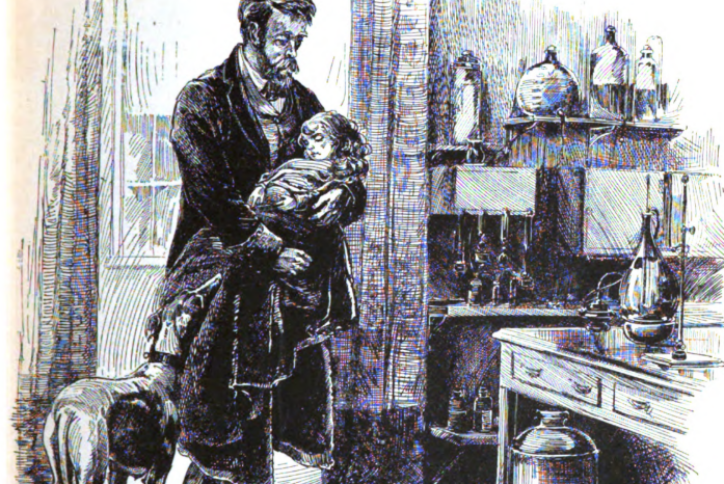
Following me the dog came thumping slowly down the steps. I shut the door upon him, lighted the gas, and laid the child in the cradle. The dog sniffed under the door and scratched at the panels. I paid no attention until his whining made it advisable to let him in, lest he should disturb the neighbors. He walked to the bench on which rested the beaker and my instruments, and sat down facing Babette. With practiced touch I opened the carotid and proceeded with my manipulations. As I turned for my platinum brush, I found that I had overlooked it on coming downstairs. I rushed to the second story. The dog remained with the child. His eyes had followed me dumbly as I left the room, and were still gazing toward the door when, with the apparatus in my hand, I re-entered. As, toward the completion of the second stage of the operation, I added the necessary alkaloid and removed the fibrin, the dog drew nearer to Babette; and when the gleaming cannula touched the subject and the process of reinjection he shivered. I closed in the usual manner the lips of the wound. On connecting the battery there were visible a few twitches of involuntary muscular action. The dog laid his chin upon the cradle. I re-established respiration as before, and welcomed the faint color returning to the features. After a few involuntary catchings after breath, the child stirred her hand slightly; Max advanced his rough head tentatively against it; after Babette had opened her eyes he went to the door. I let him out.
“The pulse was normal, the temperature nearly so, and a healthy moisture was beginning to appear upon the temples. I restored the little one to her bed; roused the nurse, who was sleeping in the salon; saying that I had bled the child, and that she was in a fair way to recover. I entered my room, was conscious of a sudden giddiness as I gazed out of the window at the tower clock of the Markt-Kirche, dim in the gray light, thought to myself that I was fainting, and came to, late in the morning, to find myself stretched upon the floor.
“What had happened? Had I been awake or dreaming? I hastened to my child’s room and bent over her. She was sleeping quietly: a linen bandage held the compress to her throat. I went to my laboratory, and, stepping over the dog, which lay before the door, found the apparatus and reagents as I had left them. I looked into the cradle. Instead of the coarse dog’s hairs that usually clung to the cushions, was caught upon the tongue of the buckle a shred of lace from the child’s night-dress.
“It was the 7th of February, 1872.
“Convalescence was steady; a few days afterward Babette called to me as I passed the room where she lay.
“‘What is it, Kleine?’
“‘Onkelchen, when can I go with thee to the Philosophenwald, and sit up at the table under the tree where the stupid Dachshund is, and drink coffee with Grete Schlosser and thee?’
“‘Why, very soon, my dear; in a month or so it will be warm, and I hope thou shalt be able to walk over the big meadow.’
“‘But oh, Onkel, I don’t think I want Grete.’
“‘And why not, Babette?’
“‘Because she will see this ugly sore place on my neck, and it is horrid!’
“‘Oh no, child, it isn’t easy to be seen, and thou canst let this little lock of hair fall over it. There! Isn’t that right?’ I asked. ‘Thou canst not have everything just as thou wouldst, Dolly. Thou art not yet Queen of Schlaraffenland.’
“‘No, Onkel, but I am queen of thee. Thou hast often said it; and now I will not go to the Philosophenwald when I am well again, but to the Heutchelheimer Mill, or to Gleiberg.’
“‘But why to the Heutchelheimer Mill, child?’
“‘Oho,’ said she, ‘because—because there was a gracious lady there one time, and she kissed me in the guest room; and she was so white,—just like Mama; so white when she slipped going down the steps to where they weighed the people and me.’
“‘Well, thou shalt go there, Babette, if thou wouldst not rather have me carry thee up Gleiberg, up to the top of the castle, so that thou canst see the far vales and villages that the beautiful Gräfin used to hold as her own. Wouldst thou not rather that?’
“‘No, Onkelchen, the mill, and the fields, where we gathered the champions! And oh, Onkel, I saw Mama the other night.’
“‘How was that, child?’
“‘Yes, Onkel Zwingli, the night that thou toldest me I was so sick, Mama did come; the pink color was in her, and she held me, oh, so soft, until I waked up. Then that horrid cloth was about my neck—but why dost thou look so queer, Onkel?’
“‘Oh, nothing, Babette,’ said I, as I left the room.”
CHAPTER VII. – A REPUTATION AT STAKE.
[The Journal continued.]
“In The Giessener Tageblatt of April the 21st, 1872, appeared an article accusing me of charlatanism; and of this article the concluding sentences ran somewhat as follows:

“‘A man who lays claim to a discovery by which life can be restored to dead organism is either a fanatic or quack. If Herr Doctor Zschorr had kept his air-drawn fantasies to himself, he might have escaped the former imputation; if he possessed the requisite boldness to submit his theories to a crucial and public test, he might, at any rate, attempt to dispel the latter. Is there room in the University of Giessen for a Privat-Docent who, rather than meet either of these alternatives, has preferred to wear the double sobriquet of maudlin mountebank? Es lebe der neue Paracelsus Bombastus! Hoch!’ ‘Thomas Erastus von Gero’
“To be called a fanatic and a quack was galling. To be called a second Bombast von Hohenheim was more than flesh and blood could stand. It was evident that I must clear myself from the charges laid at my door. Accordingly I revealed to my friend, the Herr Doctor von Norden, the principal facts of my chemico-medical discovery. He absorbed my idea with avidity, expressed his appreciation of the confidence I had vested in him, and suggested that a practical illustration of the effect of ichorine upon a dog be given, for the convincing of such skeptics as the writer of the late attack upon my character and common sense.
“Accordingly, by his advice, I put in The Giessener Tageblatt of April 25th a notice to the effect that if the gentleman signing himself Erastus von Gero would call at my house on Friday, April the 26th, at 3 P.M., I would attempt to convince him of my sanity.
“Punctual to the hour appeared my friend von Norden, and with him Professor Dr. Gersdorf, the author—as I had suspected—of the attack in the Tageblatt. I took them to my laboratory, and from my note-books gave them a synopsis of the experiments that had led to my discovery of ichorine, and a brief résumé of its physical and chemical properties.
“‘Here is the alkaloid,’ said I, exhibiting the precious substance. Its physical peculiarities and analytical reactions I explained at length. ‘Its remarkable therapeutic value,’ I added, ‘is still under test, but if added to dark venous blood, it will change the same to a bright arterial color, and that there will immediately form upon the surface of the fluid a film containing all the abnormal constituents and germs of disease that may have existed in the extracted blood. Removing this film, I have often reinjected into the subject purified arterial blood, formed from that which was previously diseased; and,’ concluded I with enthusiasm, ‘I have met with success so indubitable as to warrant me in the assertion that I have solved the problem of permanent resuscitation from death.’
“There was an amused sneer on Gersdorf’s lips; but I might as well give them the truth, even if it were a casting of pearls before them.
“‘As a medicine,’ I added, ‘you will find that in case of weakness, or even of cessation of the heart, the solution has an infallibly stimulating effect.’ I paused. Gersdorf gazed at me somewhat as if I had lost my senses.
“I presented each of them with a hermetically sealed vial, containing a few decigrams of the alkaloid; and I assured them that after I had furnished a practical test of its properties they were at liberty to do with the samples what they would. Von Norden showed himself again my friend; he placed the vial in his breast pocket. Gersdorf glanced cynically at the sample. ‘At any rate, undeniably harmless,’ said he, and he thrust it carelessly into the recesses of his coat-tail.
“I was somewhat piqued at the impenetrability of my opponent, but I prepared rapidly for my physiological demonstration.
“‘Ah,’ said Gersdorf, as I took in hand my refusion apparatus, ‘I suppose this, also, is one of your inventions?’
“‘No,’ said I curtly, ‘it is not.’
“‘It is interesting,’ remarked Von Norden.
“‘And ingenious,’ I added; ‘tis the idea of an American friend of mine called Hutchinson. After extracting the blood from the dog before us, and purifying it by means of my alkaloid’—Gersdorf strolled toward the window—‘I shall pour it,’ continued I, raising my voice, ‘into the receiver of this refusion apparatus, and then, introducing the cannula into the carotid of the dog, I shall reinject the blood.’
“I proceeded to my demonstration. It need not say that it was successful.
“‘Well,’ said Gersdorf, as the dog staggered to his feet, ‘the brute may have been dead or he may not. Your demonstration is indeed an interesting piece of ganzerei, of jugglery, but, from a scientific point of view, practically valueless.’
“‘I am inclined to think,’ rejoined Von Norden, ‘that the experiment was conducted in perfectly good faith, and that it may result in a momentous revolution in the art of therapeutics. It is a pity that Ober-Clinical-Director Werner should have refused you permission to test your theory by a clinical demonstration.’
“‘He was perfectly right,’ retorted Gersdorf, ‘in refusing to allow any such crackbrained empiricism to be perpetrated in his amphitheater. Had the attempt been made upon a human being, and with success, I might be induced to consider it worthy of attention.’
“‘Of course,’ said Von Norden, ‘a brute will do for experiments, but demonstration requires a human subject.’
“‘Von Norden,’ said I, ‘upon your secrecy I know I can depend, and if the Herr Doctor Gersdorf will lay aside his air of condescension, and meet me on terms of equality, I will divulge to you what to me is of momentous importance. In the interests of humanity, can I depend upon your silence?’
“Von Norden promised immediately. Gersdorf, whose interest was speedily attaining such proportions as to be inconsistent with the supercilious air which he had assumed, after much hemming and hawing, consented.
“‘In Gottes Namen,’ said I.
“‘In Gottes Namen,’ they repeated.
“‘Herren Professoren Gersdorf and Von Norden,’ said I, ‘once in a case of extreme urgency have I made the experiment which you require; and with success. I am confident that I can again succeed.’
“‘Upon whom?,’ cried both, starting to their feet in surprise.
“‘Upon my niece.’
“‘Donnerwetter, you lie!,’ said Gersdorf.
“‘Herr Dr. Gersdorf, you answer for this insult at a more fitting time,’ said I.
“‘Nicht so eilig,’ said he. ‘I am perfectly willing to retract my words if you can prove the truth of your statement.’
“‘So be it,’ replied I, resolved in my madness to win or to lose.
“I took a bottle of chloroform from the shelf, poured a few drachms upon my pocket-handkerchief, placed it in the breast pocket of my coat, took the coat off, threw it over my arm, and ascended to the second story.
“‘Babette,’ said I, as I entered the room, ‘so thou hast just come home from the Heutchelheimer?’
“‘Yes,’ said she, ‘and the Parson Schlossser carried me part of the way, and said that my heart went strong again like the millwheel. Was that not pretty? And the Kaiser’s cornflowers are just peeping out, Onkel?’
“‘Well, that must have been fine, Babette. Next time I will go with thee myself; but now canst thou tell me where that needle is that I lent thee yesterday? I would sew on one of the buttons of this coat.’
“‘Oh, let me sew it on, Onkel!’ cried she. ‘I can sew so neatly now, since the Tante Amalie taught me at the sewing-school. But hast thou the button, Onkel? Those big horn buttons! How would a pearl one do, such as the Tante put on my holiday-gown? Would that not be right pretty, Onkel Zwingli?’ laughed she.
“‘Perhaps I dropped it in my bedroom,’ I replied. ‘Wilt thou help me look for it?’
“She rose immediately. ‘Ach! I am so tired,’ she murmured. ‘The Dachshund would jump upon me, though I told him not to.’
“‘Poor little woman, let me carry thee!’ I lifted her in my arms and wrapped the coat about her. ‘Is not that better now?’
“‘Thou hast such queer smelly things in thy work-room, Onkelchen, such queer smelly things,’ said the child, ‘and I feel so sleepy.’
“Her head sank lower as she yielded to the influence of the opiate.”
CHAPTER VIII. – THE SECOND OPERATION.
[The Journal continued.]
“I took her downstairs, and proceeded to repeat the operation of the night of February the 7th.

“Von Norden and Gersdorf drew their chairs to the side of the work-table. During the period of extraction Von Norden’s face was gray as ashes; Gersdorf, gripping the arms of his chair, half rose in his seat, and leaned forward in nervous interest. His cigar fell from his lips. He passed his tongue between them as if they were dry; he drew himself up, smiled spasmodically, and rose to his feet; he took a cigar-case from his pocket and from it a cigar, the tip of which he cut off and wrapped up in a dirty scrap of paper such as he always carried for that purpose. He replaced the package carefully in his vest pocket; then stuck his cigar unlighted between his teeth, and pulled at it violently. Although I endeavored, by concentrating my attention upon the subject of the experiment, to ignore the presence of Von Norden and Gersdorf, their entity was continually included in my field of indirect vision. Their gaze unnerved me. I felt my fingers twitching, but I controlled myself. I had for the last time agitated the contents of the beaker, and had taken down, from the shelf above, the bottle containing the alcoholic solution of my alkaloid.
“‘By the way, Von Norden, can you give me a light?’ remarked Gersdorf.
“A perspiration broke out upon me; my limbs trembled violently. The glass rod with which I was dropping the alkaloid into a graduate slipped suddenly through my fingers. I clutched frantically after it; it glanced from the edge of the bench and crashed through the beaker on the stand below.
“‘Good God!’ cried Gersdorf, starting to his feet.
“‘And now what?’ gasped Von Norden, as the blood spattered upon the floor.
“‘A mere accident,’ said I, in a moment positively calm. ‘I have often, in my experiments upon dogs, restored them to animation by simple transfusion, and in this case I shall insure success by transfusion from myself, using ichorine to prepare the fluid for circulation. Von Norden, will you see to the addition of a few cells to this galvanic current, while I go downstairs for another beaker?’
“I descended the stairs,—staggered into the blindness of the storeroom. The light struggled feebly through cobwebs on the glass-paneled door. Mechanically I stretched my hand to a beaker on the shelf beside the transom; I suffocated; opened the door for air. It smote me—what I had done and what I was. I reeled, and supported myself by the door-jamb. A peasant girl from Kelberg passed by, singing:
‘Das muss von Liebsten was man hat,
Muss scheiden.’
“Her two dogs, with their tongues hanging out, strained at the traces of the milk-wagon. They stood still as they saw me.
“‘Have some milk for Babette?’ asked the Bauer-mädchen.
“‘Not any to-day,’ I replied.
“I sickened at the thought of re-entering the room. It was useless. I passed up the cellar steps under the windows of the laboratory in which they waited in the court. They might have seen me. I walked rapidly down the Schor and hastened by the Bauer-mädchen. She was still singing. I heard her as I traversed the Faast and South Anlagen, and left the botanical gardens behind.
‘So dir geschenkt ein Kußplatz was
So that es in ein Wasserplatz,
Doch eins—’
“I hastened up the Bahnhof Strasse. As I was even crossing the bridge close by the railway station, whom should I run against but Buchner—Gymnasial-Director Buchner.
“‘Ach,’ cried he, ‘what was in my mind, Herr Doctor? Whether are you going? I thought you had the purpose to meet this afternoon your friend of The Tageblatt, and in Himmel, also! This very hour. Have you forgotten? Have you thrown him over the heap?’
“I moved away, for the train was just pulling in. ‘No,’ answered I. ‘I challenged him to the test, but he has not made an appearance.’
“‘Whew!’ whistled Buchner, and he turned to go with me. ‘Walking off your exultation, eh?’ and he chuckled.
“‘Yes,’ said I. ‘I walk to Gross Linden.’ Buchner does not walk with willingness. He left me.
“I entered the Bahnhof, and purchased my billet for Coblentz. In not many minutes we had whirled by Fetzerberg and Gleiberg on the right, and I gazed upon them as they gathered vagueness. Often with light heart I had climbed those ruins. Upon them sat a cloud, and in the folds thereof was wrapped my consciousness. I breathed. I was bound I knew not whither. I had forgotten those ancient mushrooms that I gathered for my child,’ thought I. I put my hand into my pocket. I had not thought to give them to her.

“A something cold and hard it was that met my fingers. I drew it forth and dropped it. I must have called aloud. The Schaffner, clambering along the footboard outside, thrust in his head and demanded my ticket. I gave it him. There was no one in the apartment, and I gathered up the fragments of my apparatus for extraction. I must have thrust it carelessly into my pocket upon leaving the room in which Von Norden and Gersdorf still were standing. Even now the presence of it cuts my soul. It is beside me.
“At Coblentz I took the steamboat Kaiser Wilhelm. I thought this might be the safer way to travel. I looked my last at Drachenfels and Rolandseck. At Neuwid my brother had lived. I held my face toward what we left behind. I saw not the Kölner Dom till we had passed it. I sailed down the stream to Rotterdam. I had no hopes, no fears; for I was as one dead. With Hungarian miners I crossed the ocean. I was not one of them; of the human kind I am not one. My squirrels they know me. My hound opens now her eyes, and with her look she is beholden to me. My chipmunk gnaws the wires of his cage, but would not hence. I have given him freedom; he abides. Of men I am not. Him whose hands are evil the brutes suffer. Of my heart they have not knowledge.
“This I have written, and I have striven to write it without passion or prejudice. I, Zwingli Zschorer, number 192 on the payroll of the Pennekawab mine, March 26, 1873, find that Herr Doctor Zwingli Zschorer, Unter-klinical Director of the University of Giessen, has, in his presumptuous effort to confer upon men that boon which God has denied them, played the fool and the murderer. An unworthy vessel, I, to hold the grace that overmasters death. The man of God went up and stretched himself upon the son of the Shunamite, and the child opened his eyes. Mine, alas, was but the staff of Elisha in the hands of Gehazi!”
—
Here the Journal closes. The remaining pages, from 213 on, are blank. I looked up number 192 on the pay-roll of the Pennekawab for 1872 and 1873, and found that under that number one named Z. Zschorer was earning about forty-seven dollars a month. The only other clue that I have obtained with regard to the man was from an old pit-boss who had worked in the mine before the accident of ’73.
“‘Zschorer—Zschorer,’ said he; ‘I mind he; he be long drivin’ of a cross-cut off B shaft wi’ Merysfeld, and Nankeevil and one o’ they Scandinavians. Caved in—weren’t en? I dunno much about he. Too horrid quick wi’ his fists. One noon-hour, I mind me, I were a-sittin’ in ’is shanty a-takin’ o’ my mate, and a bloody rat com’ be’ind and ran hof wi’ a ’alf o’ my saffurn cake. I thraved a ’ammer and took un in the back of the neck, and pasted ’is bloody grinnin’ mug hall over my ’oman’s new pail.
“‘But, what’s-a-think? That Dutchman was some mad. He up and told me summut like he’d be long killin’ o’ me, if I done that again wi’ one o’ his rats. There were none for you and the beasts too! Dear life, but he said some pile damn!’”
(To be Concluded.)