CHARACTERS.
- HENRI LATOURNELLE, member of the Council of State. A handsome young fellow, but a little stiff; affects a gravity of demeanor beyond his years.
- MADAME DU VERNAGE, his mother-in-law.
- ODETTE, his wife.
- BAPTISTE, a man-servant.
- JULIE, a maid-servant.
[The action of the piece takes place in Paris.]
SCENE I.
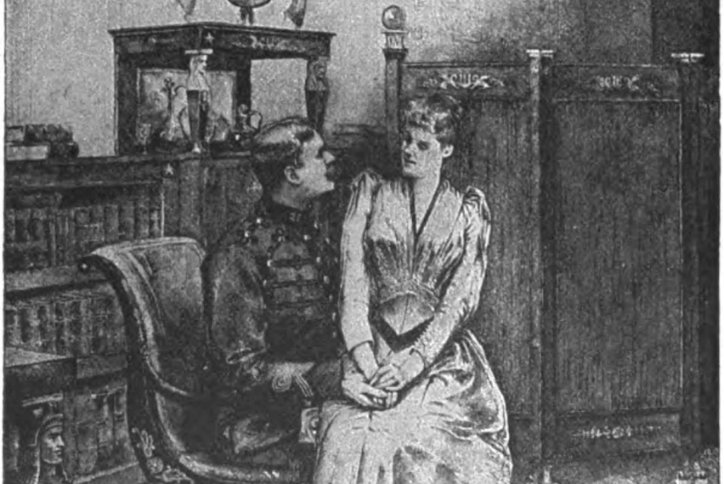
[An elegant boudoir, lamps lighted and a fire on the hearth. Latournelle alone. He walks abstractedly up and down the room, stopping every few moments to look at his watch. Enter Baptiste, who lays newspapers on a table.]
LATOURNELLE. Have the ladies returned?
BAPTISTE. Mme. du Vernage has just come in, sir, but madame has not got back yet. (Exit Baptiste. Latournelle begins to pace the room again. In a few moments Mme. du Vernage enters.)
MME. DU VERNAGE. Good-day. (Latournelle bows coldly.) Hasn’t Odette come in yet?
LATOURNELLE. No, madame.
MME. DU VERNAGE (throwing herself into an easy chair). Poor child! However, it’s only seven o’clock, and—
LATOURNELLE. Precisely; and as she has only been out since noon—
[Mme. du Vernage, without answering, takes some work from a basket and proceeds to crochet. Latournelle walks once or twice around the room, then suddenly stops before his mother-in-law.]
LATOURNELLE. Now, really, what a life your daughter is leading!
MME. DU VERNAGE (calmly). A very agreeable one, my dear sir. She calls on her friends, and visits the Louvre, the Bon Marché, the Printemps. Then we go together to see whatever is worth seeing—the museums and exhibitions, for I accompany her now whenever I can since you ceased to pay her that attention, at least in the daytime, and have taken to sulking, but what at, I’m sure I don’t know.
LATOURNELLE. Yes; but you do know, dear madame. During the first months of our married life I was everything Odette could wish, and I must add that her own conduct at that time was perfectly proper. But for the last seven or eight months she has begun to act like some wild steed. In fact, she rushes up and down Paris like an insane person. Out at daybreak, she scarcely gets back in time for dinner; and when I attempt to question her as to how she spends her time, she makes only vague, embarrassed replies, which, while they do not cause me uneasiness, are certainly very extraordinary.
MME. DU VERNAGE (quietly going on with her work). Tax your memory a little, my friend. Your wife did not begin to spend her time in the way that seems to offend you so seriously until you had left her to herself, allowing her to see how you despised her poor little person. You seemed to avoid her society, and to dislike being alone with her. In fact, I’ve seen you more than once go to sleep, or pretend to do so, in her presence, which, you must confess, couldn’t have been pleasant for her.
LATOURNELLE. And whose fault was it, madame, that intercourse between us became impossible? That your daughter never had anything to say for herself when I spoke to her?
MME. DU VERNAGE. You were all the time talking politics.
LATOURNELLE. Not politics; I talked literature, the fine arts, history, natural philosophy; in short, I knocked at every door, but found them all barred against me. Well, madame, I ask you again, whose fault was it? I was not acquainted with your daughter when I married her; one’s acquaintance with one’s future wife is usually extremely slight; but you, madame, knew her thoroughly, and you also knew me. You knew that, while not objecting to ordinary fashionable amusements, I am a man with a taste for serious occupations, a busy man in fact, whose mind shows signs, if I may be allowed the expression, of—of—cultivation. You knew, on the other hand, that your daughter, although well dowered physically, was a person of utterly frivolous tastes, without a particle of intellectual training, having never read anything, and totally unqualified to bear her part in any really interesting conversation. Well, how did you arrive at the conclusion that the union of such an ill-assorted couple could ever prove a happy one?
MME. DU VERNAGE (coldly). Having educatedmy daughter myself, I was unable to teach her what I did not know.
LATOURNELLE. But this is precisely what I am complaining of. You must be aware of the fact that there is now a demand for young women possessing a kind of education, and an amount of general information, that were not required of the generation to which you belong. Feeling your own shortcomings, you should have engaged a few masters for the accomplishments. But I should like to know what it was you taught your daughter?
MME. DU VERNAGE. Politeness, my friend.
LATOURNELLE. She doesn’t even know sacred history. I recollect that one day when we were at the Salon she inquired the name of a picture. I replied that it was a Salome. “Who’s she?” she asked, a question that made every one smile around us. Perhaps you don’t think this is mortifying to a husband; perhaps you think it encourages him to take his wife to the museums and elsewhere.
MME. DU VERNAGE. I admit that when I taught my daughter her Bible, I did not think it necessary to dwell on the story of Salome.
LATOURNELLE. The fact is that, with your old aristocratic ideas and your reactionary tendencies, you also have a holy horror of modern progress, and especially of advanced schools for young women. If you had had the sense to place your daughter in one of those admirable institutions—
MME. DU VERNAGE (throwing down her work). If I had placed my daughter in one of those admirable institutions, I should have committed a crime against her future husband.
LATOURNELLE (sarcastically). Then you intended that she should marry either an ignoramus or a fool?
MME. DU VERNAGE. On the contrary, I intended her to marry an educated man, a man of brains, and I wished to leave to him the precious privilege of cultivating my daughter’s intellect, or, at least, of shaping it according to his own ideas. I hoped that he would understand how much of gentleness and strength the relation of master and pupil could infuse into the bonds that unite a newly-married couple. I should consider myself culpable if, in advance, I deprived my son-in-law of the prestige he should enjoy in his wife’s esteem; for if a young wife doesn’t admire her husband, it is because she is not sufficiently in love with him. Understand me. He must be in her eyes a superior being, a kind of archangel, who deigns to lift her on his wings and gradually raise her into the pure ether! Ah! you have no idea how such a course of training, an almost insensible one, which seems only another and graver phase of love, touches and softens and binds a young wife’s heart. But no, you would like to have your partner for life come forth from an advanced school in complete educational armor, like Minerva from the brain of Jupiter. I’ve heard of this vaunted system of teaching girls everything before marriage; but when you are thus shaping her mind in an official mold, are you quite certain that you are not forcing her into an attitude of opposition, nay, even downright hostility on more than one subject, to the man she will hereafter marry? May not these opinions of hers on all possible topics, which you insist on forming, come in conflict with those of the one whom she promises to love, honor, and obey? May not, in short, all this knowledge, so toilsomely acquired, prove displeasing to him? Might it not come to pass that the husband, in some cases, may prove after marriage to be the less learned of the two, and thus suffer in his own esteem; while the wife would not be able to repress a feeling of contempt for the man she should look up to? In view, therefore, of all these considerations, and others that I pass over, I am in favor of a mother’s perfecting her daughter’s moral education, and contenting herself with merely sketching the course of intellectual training she should pursue, giving her, as Molière says, “a little information about everything,” and preparing the ground for the husband. I have so understood my duty, and I have discharged it. Allow me to ask if you have been equally faithful to yours?
LATOURNELLE. And I ask you, madame, what your daughter would have said if I had proposed to send her to school for two or three hours every morning? for nothing less would have answered the purpose.
MME. DU VERNAGE. It is not a question of going toschool; it is a question of embracing such opportunities as may offer themselves from day to day of enlightening her mind, correcting her opinions, refining her taste, elevating her thoughts. Certainly such opportunities are not wanting in Paris!
LATOURNELLE. Pardon me, my dear madame, I am about to touch upon a very delicate subject. With every wish in the world to respect your maternal illusions, I can not disguise the fact that you count too much on your daughter’s natural ability. In my opinion she is so utterly frivolous as to be incapable of any serious application.
MME. DU VERNAGE. Ah! my friend, if you only knew how I want to laugh at you.
LATOURNELLE. Well, then, madame, I can assure you that I see nothing to laugh at, for frivolity carried to such a point is not only not ludicrous, but dangerous. It constitutes a moral disease that hurries wives down a fatal declivity ending in forgetfulness of duty! Among all these light-headed ones who pass their lives in running from one shop to another, in flirting around the lake in the Bois de Boulogne, and then stuffing themselves with sandwiches, pâtés de foie gras, and Malaga until dinner-time, are you acquainted with many that are really virtuous? As for me, I know but few who come within that category. In short, madame, to be entirely frank, your daughter is in a fair way to lose my confidence; in fact, she has lost it!
MME. DU VERNAGE. Allow me, my friend—
LATOURNELLE. For there is not only folly in the life she is leading, there is mystery and—equivocation. Odette is no longer open and above board with me; more than once I have caught her deceiving me as to the employment of her time. Besides, she frequently shuts herself up in her room, and she has secret drawers in which she conceals something, apparently letters that she has written or received. Three days ago, when I happened to come in rather suddenly, I saw her push a lot of papers into some hiding-place, while she turned red up to the very roots of her hair.
MME. DU VERNAGE. Well! this is a little too much! I can’t keep back the truth any longer. It is you, my dear sir, who are about to blush up to the roots of your hair. I will tell you what this little frivolous, childish, incapable wife of yours has been concealing from you. It was her diploma for having taken the first prize at the recent examinations at the Hôtel de Ville.
LATOURNELLE (dumbfounded and somewhat incredulous). My dear madame, you don’t tell me so!
MME. DU VERNAGE. True, I assure you, my dear sir; but that is not all. She is now preparing herself for the July examination to secure a still higher diploma. You now know how she has passed her days during the past six or seven months. She has been attending lectures, and when she has shut herself up in her room, it was to correct her notes or to sketch. Come, don’t, I beg of you, try to conceal the tear I see in the corner of your eye. It does you credit, and makes me forget your previous impertinence. _(Taking his hands.)_ Yes, you were really unhappy, my poor fellow!
LATOURNELLE (greatly moved). Very unhappy.
MME. DU VERNAGE. Then you love my terrible daughter a little after all?
LATOURNELLE. A great deal. (He kisses her hand.)
MME. DU VERNAGE (gently withdrawing it). No, not me, not me, you mustn’t thank me; no one but her. For really, I was not very much in favor of it. I saw the objections, how inconvenient it would be, but she insisted. “I don’t mean to leave him any excuse, mamma,” said my little girl. _(Listens.)_ There she is now. How disappointed she’ll be when she finds that I’ve revealed her secret! She wanted to keep it from you until after the July examinations.
ODETTE (entering quickly). Here I am; a little late, but— (Stops as she notices that her mother and husband seem embarrassed, and then adds in a lower tone.) What can be the matter?
MME. DU VERNAGE. My daughter, you will scold me, but your husband was greatly annoyed. He suspected some plot; he was really anxious. I told him everything.
ODETTE. Oh, mamma!
LATOURNELLE (holding out his arms). Embrace me! (She runs to him, much affected.) My darling! How nice of you! How charming!
BAPTISTE (appearing at back of stage). Dinner is ready, madame.
SCENE II.
[The Dining-Room. A table laid for dinner. Latournelle, Mme. du Vernage and Odette enter, talking and laughing gayly. They take seats. Baptiste busies himself waiting on them.]
LATOURNELLE (laughing). What surprises me most is that none of your lady friends told me.
ODETTE. Oh! they didn’t know.
LATOURNELLE. Good!
ODETTE. But oh! the number of stories I’ve told and the tricks I’ve been compelled to resort to.
[They begin to eat.]
LATOURNELLE. You must show me your note-books. I should like to see them.
ODETTE. You shall see everything.
LATOURNELLE. And do you really think of trying for the higher diploma?
ODETTE (very animated, and somewhat excited). Certainly; and I shall get it.
LATOURNELLE. But the examination for this higher diploma is no laughing matter.
ODETTE. I know it, and I shall take plenty of time. Then I’ve such excellent professors. M. Chevreau-Lambert for French and literature—
LATOURNELLE. Chevreau-Lambert! the deuse!
ODETTE. The very same. M. Renaudot for history and geography; M. Tellier for the sciences; Hamel-Druot for drawing—in short, the aristocracy of the guild of educators.
LATOURNELLE (to Mme. du Vernage). Tell me, dear madame, did you accompany Odette to her lectures?
ODETTE. Yes.
LATOURNELLE. Why, it isn’t worth while. I’ve no doubt you know all about it.
MME. DU VERNAGE. But, my friend, since it would please her—
LATOURNELLE (embarrassed). Well, let me see; in chemistry. What is gas?
ODETTE. What kind of gas?
LATOURNELLE. Illuminating gas, the kind in the chandelier, for instance.
ODETTE. Hydrogen.
LATOURNELLE. Splendid! That’s enough! (To Mme. du Vernage.) She knows it; she knows it.
ODETTE (gayly). Will you give me a little chloride of sodium, my dear? (Latournelle, after a moment’s hesitation, hands his wife a bottle of mineral water standing near him.) No, Henri, I said chloride of sodium, and you give me St. Gallmier water, c-h-l-o-r-i-d-e, chloride, s-o-d-i-u-m, sodium, chloride of sodium—common salt.
LATOURNELLE. Oh! chloride of sodium? That’s it. (Passes the salt-cellar.) And as to history, my dear. Are you as well informed regarding history as you are about chemistry? However, I believe you are not questioned on anything but French history in these examinations.
ODETTE. As regards the first degree, yes; but for the second, general history is required. I have already learned, or reviewed, the greater part of it.
LATOURNELLE (laughing). Then I suppose you know who Salome was, now.
ODETTE. Of course. Salome was the daughter of Herodias, Herod’s second wife. Herodias was also Herod’s sister-in-law, and it was this marriage, regarded as unlawful by the Jews, that provoked the upbraidings and anathemas of John the Baptist. In order to be revenged, Herodias swore that she would have his life. She asked Herod for his head through her daughter, Salome, who obtained it by fascinating him by her dancing. There is even reason to suppose that there was something less innocent than dancing that I can not now refer to, but in such a family—
LATOURNELLE (evidently annoyed, interrupts her). How? What are you talking about, Odette? I’ve never heard any such hypothesis advanced.
ODETTE. M. Renaudot, however, says that it is quite probable, and that otherwise it is impossible to explain rationally the sanguinary deed for which Herod allowed himself to be made responsible, seeing that naturally he was not a cruel prince.
LATOURNELLE (who has been listening with increasing signs of disapproval). What, not cruel! Herod not cruel! What about the massacre of the innocents, my dear?
ODETTE. Pardon me, my dear, you seem to be confusing two Herods. The one who slaughtered the children was Herod the Great, 40 B.C., while mine, Salome’s, was Herod Antipas, his son, 1 A.D.
LATOURNELLE. Are you sure?
ODETTE. Yes, my dear.
LATOURNELLE. As for that, the history of those times is somewhat uncertain.
MME. DU VERNAGE (coughing). Ahem!
LATOURNELLE. You were saying, my dear madame—
MME. DU VERNAGE. Nothing, my friend.
LATOURNELLE (eating). These shrimp croquettes are simply delicious. You must have been terribly bored, my poor Odette, by seven months of such abstruse studies.
ODETTE. Not at all. You know what the poet says: ““Le travail est souvent le père du plaisir.”“
LATOURNELLE. Boileau. Very good; very good! But it must be remembered that this is not one of his happiest lines—
ODETTE (simply). But it is not Boileau, my dear; it is Voltaire.
LATOURNELLE (somewhat annoyed, but recovering himself and affecting to laugh). Bravo! So you fell into my trap.
MME. DU VERNAGE. Why, I’ve been compelled to do so to pass my examination. I’ve had a writing-master, and you’ll be agreeably surprised to find what an artist I’ve become.
LATOURNELLE. Ah! the worthy Boileau this time.
ODETTE (gayly). Come, admit that you are doing it on purpose.
LATOURNELLE. How so? Isn’t it Boileau?
ODETTE. You know very well that it’s Brébeuf—in “La Pharsale.”
LATOURNELLE. Oh! yes, Brébeuf. I must confess that I had somewhat lost sight of Brébeuf.
MME. DU VERNAGE (to whom he has given his arm). She’s well read, isn’t she?
LATOURNELLE (surrendering at discretion). Very much so.
MME. DU VERNAGE. And only think how much she’ll know when she has taken the higher diploma! (They pass into the boudoir.)
[Baptiste and Julie enter to clear off the table.]
JULIE. What can they have been going on so about to-day? We could hear them in the kitchen.
[Just then Latournelle comes back from the boudoir and raises the portière.]
BAPTISTE (not seeing his master). Well, you’ve lost your bet! Madame was in monsieur’s arms most of the time. What made me laugh—— (Turns and sees Latournelle.)
LATOURNELLE (severely). Go, please, and get the cigarette case in the pocket of my outside coat.
BAPTISTE. Yes, sir.
SCENE III.
[The boudoir. Mme. du Vernage and Odette alone.]
ODETTE. You don’t mean it, mamma? Did he really suspect me?
MME. DU VERNAGE. He didn’t exactly suspect you, but he was getting very uneasy, a trifle jealous, in fact. But you shouldn’t complain of that, my child.
[Enter Latournelle.]
ODETTE (taking his hands). So you were jealous, you wicked man! You suspected me!
LATOURNELLE. Not at all. Only there was a mystery I could not fathom.
ODETTE. Make your mind easy, my poor boy.
_”Mon âme vierge encor, dans le sommeil des sens,
Les folles passions ignorent les tourments.”_
LATOURNELLE. How gratifying all this is, to be sure.
ODETTE. Introduced to bring in my quotation. You know the author, of course.
LATOURNELLE. Indeed, I don’t. Wait a bit, though. It must be from Racine—Hippolyte in “Phèdre.”
ODETTE. Another challenge? No, they’re Legouvé’s. Now, my darling Henri, I’m going to bring you my diploma, my notebooks, and my “relief” sketches, and you’ll see how hard I’ve worked to please you.
[She runs out of the room, returns and raises the portière.]
ODETTE. Where are they from?
LATOURNELLE. Probably Corneille, in the “Cid.”
ODETTE. Nonsense; they’re from Lafontaine. (Exits.)
LATOURNELLE (takes two or three turns up and down the room while smoking a cigarette, then throws the latter into the fire and sinks into a chair, utterly prostrated.)
MME. DU VERNAGE. Well, dear friend, you seem somewhat stupefied.
LATOURNELLE. Stupefied is a rather strong expression; “bored” would express my condition better.
MME. DU VERNAGE.Why “bored”? You wanted an educated wife, and you have one. What do you wish for more?
LATOURNELLE. True, I wanted an educated woman for a wife, but I did not sigh for a female _savante_ of the Molière species, a pedant ever ready to make a display of her insupportable erudition. Why, one cannot even open one’s lips to say a word without seeing it made the text for a scientific commentary, a grammatical observation, or a literary quotation. It’s terrible.
MME. DU VERNAGE. At any rate, you have to repeat what I have already had the honor of observing—that if you had condescended to direct her education yourself, you would not only have taught her what it is desirable for her to know, but you would have taken pains to keep her ignorant of those things that she ought not to know, and all would have been well. And were it not that I might appear to be wanting in the deference due you, I would add that you seem somewhat inconsistent. When your wife appeared to be ignorant and frivolous, you cried out like a peacock. She studies, educates herself, takes infinite pains to please you, and you are even more dissatisfied than you were before. If you wish to drive her out of her senses, you are going the right way to work to secure that end. But, as you have not quite taken leave of your own, I trust that you’ll soon be able to see matters in their true light. Good evening. (She rises to retire.)
LATOURNELLE. No, I beg of you, dear madame, do not abandon me in so trying, so critical a situation. I acknowledge that you are an excellent counselor. Kindly deign to advise me. I really wish Odette to give up these studies, which, I repeat, are directed with the worst possible judgment. How can I intimate this to her without wounding and discouraging her?
MME. DU VERNAGE. Come down from your high horse. Appeal to her affection, let your heart speak to hers. There is no better course with us women. Shall I go, or stay?
LATOURNELLE. Stay, by all means.
MME. DU VERNAGE. Like Arnold. (Sits.)
[Odette enters with note-books and rolls of paper.]
ODETTE (gayly laying them on the table). In the first place, there’s my diploma.
LATOURNELLE (looking at it). You mean to give it to me, don’t you? I shall keep it as one of my most valued treasures.
ODETTE. How kind of you. Here are my notes.
LATOURNELLE (glancing over them). Why, little one, how you must have worked. It’s really frightful, terrible! But this great roll?
ODETTE. My “relief” drawings. (Unrolls one and shows it to her husband.)
LATOURNELLE (admiringly). And pray, what is that?
ODETTE. That? An acanthus leaf from the temple of Mars the Avenger, and this is a molding from the same edifice.
LATOURNELLE. This full relief is capital; and remarkably well done, really remarkably. (To Mme. du Vernage.) Is it not, madame? Look. (Passes the drawing to Mme. du Vernage.)
MME. DU VERNAGE. Yes, my friend, excellently.
LATOURNELLE. And say, my dear, don’t you think you now know about enough?
ODETTE. Of course I don’t. I must have the higher diploma.
LATOURNELLE. To please me?
ODETTE. Certainly. In the first place, to please you, and then—
LATOURNELLE. And then?
ODETTE (coaxingly). And then to please—myself; because I hope—in fact, I’ve always said to myself that the day I brought you the higher diploma, you would give me a horse, a nice little horse.
LATOURNELLE. Now if I should give you the horse tomorrow and a great big kiss now, would you be willing to give up the idea of taking the diploma?
ODETTE (presenting her cheek). Try me.
LATOURNELLE (kissing her). It’s a bargain.
MME. DU VERNAGE. Well! you are not as stupid as I thought you were. You may kiss me too, my friend. (Kisses her. Curtain.)