MANY legends are related to the wild sea-coast of Princess Anne County, Virginia, which is the triangle between the southern shore of the Chesapeake and the Atlantic Ocean. Some of these stories refer to wreckers plying their criminal trade on the ocean side, but one of the most curious is connected with Lynhaven Bay and the inundation that formed it.
This bay, now covering a large expanse of the country, once had no existence; it was the result of a freak on the part of a single man, Giles Hernshaw, a fisherman living in a cabin near the banks of the Chesapeake.
Hernshaw was a rough character and bore a very bad reputation. He was a man of about fifty, of great personal strength, with a shag of hair nearly covering his low forehead, and a harsh and forbidding expression. There was very little doubt that he was a wrecker, but no one had ever charged him with it. In fact, he was rarely seen except when he was dragging his nets in the bay, or at the courthouse, where he went to sell his fish and fill his jug with whisky.
An incident on his return from one of these visits will indicate the ferocity of his character.
He had once been arrested for creating a disturbance and sent to jail by Colonel Hartwell, a magistrate. On this occasion, he was heard to say with a scowl, “I’ll have my heel on him sooner or later.” Some months afterward, Colonel Hartwell died and was buried in the graveyard of Lynhaven church, where a tomb was erected over him, consisting of a flat slab with his name inscribed upon it, and a tall stone cross rising as a headstone.
Hernshaw passed Lynhaven churchyard with two of his rough associates a few days after its erection, and seeing the monument, leaped over the wall and went toward it. Having reached it, he mounted on the slab, ground his heel on Colonel Hartwell’s name, and then, shaking his fist at the cross, rejoined his companions.
At the time, he had a wife living, and one of the party told her of the incident with rude laughter. The poor woman turned pale. Taking a cross hanging around her neck, she held it up and muttered a prayer that her husband would one day cling for safety to it; and these were nearly the last words that she spoke. She died not long afterward while giving birth to a daughter, her only child, and then Hernshaw was seen to have something human in him. The one soft spot in his coarse heart was his love for his baby. He engaged an old crone to come and live with him and look after the child, but he never seemed satisfied when she was out of his sight.
He had made her a cradle of the planks of a wrecked vessel, and his favorite occupation was to watch her sleeping in front of the cabin. When she awoke, he would fondle her, listening to her prattle and admiring her winning ways; and one of these always filled him with superstitious awe. As the poor mother was dying, she had taken the cross from her own neck, hanging the ribbon around the child’s; and now this cross was her favorite plaything. The child would grasp it as soon as she awoke, hold it up, and put it to her mouth as though she were kissing it. And Hernshaw, looking on, would feel a thrill pass through his frame, as though his dead wife were present and repeating her last words to him.
When not thus engaged, Hernshaw was busy dragging his nets in the bay or turning over in his mind a scheme that had long occupied him. His cabin stood near a small stream called Little Creek, running parallel with the shore and emptying into the bay about three miles off. To reach the fishing grounds, he and his associates were obliged to pass this inlet, making a journey of six miles daily; and Hernshaw had conceived the project of opening a shorter route. The level sandbar, extending between Little Creek and the bay, was less than a quarter of a mile in width; and by cutting through this obstacle, they would be able to make a channel wide enough for the boats.
By dint of thinking and talking, Hernshaw had at last arranged everything with his associates, and the work was to be attempted. On a bright summer morning, he left his cabin with a broad field-hoe on his shoulder to go to the place of rendezvous. The cradle containing the baby was standing in the sunshine at the door, and the child was asleep. Hernshaw stood for a moment looking at her; then he stooped down and touched the small face with his bearded mouth, and cautioning the old woman to take good care of the child, went to meet his companions.
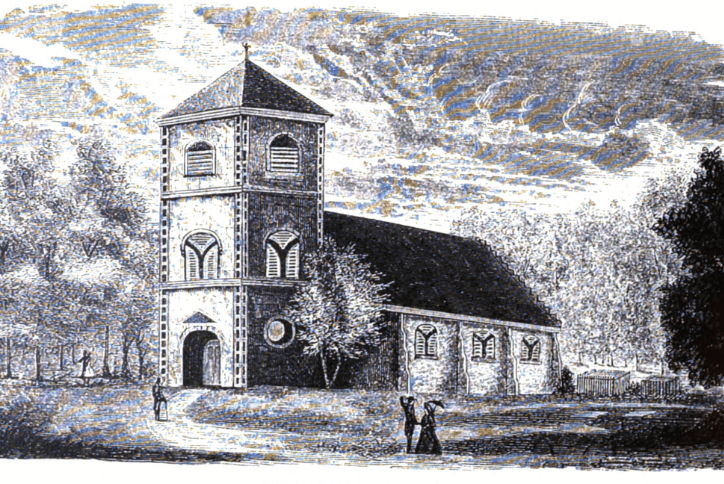
The spot selected for opening the channel was about a quarter of a mile from the cabin. The landscape was wild and lonely. A flat expanse extended inland, clothed with wire grass and shrubs; and the only building in view, except the cabins of the fishermen, was the ancient Lynhaven church, where the slate roof rose from a group of pines about a mile distant. Hernshaw glanced in that direction, and a singular expression came to his face. He had caught a glimpse of the cross over Colonel Hartwell’s grave gleaming in the sunshine and turned hastily in the opposite direction.
Here the prospect was wilder and lonelier. Nothing was seen but the melancholy sand dunes and the misty expanse of the Chesapeake beyond. A strong wind was blowing from the Atlantic, and the waves broke with a muffled roar on the long dike of the sandbar. Above this threatening murmur rose the shrill scream of sea-fowl, and another sound which Hernshaw recognized—the loud boating songs of the ‘longshoremen.
He even joined them, about twenty of the roughest characters of the coast, and as they had brought plenty of drink, the work began with ardor. The men looked to Hernshaw as their leader, and followed his directions with implicit obedience. All that was needed, he said, was to dig a narrow trench only a foot or two wide and a few inches deep, and then the water of the bay would wash through and open the channel. The ‘longshoremen answered with shouts, and the heavy field-hoes rose and fell rapidly. The bar was nearly on a level with the water and consisted only of loose sand, so that by a little past noon they were half across. Then they rested for half an hour, eating, drinking, and singing their songs, and resuming work, proceeded rapidly until, just as the sun was sinking, they found themselves within a few yards of the bay.
Suddenly one of the oldest ‘longshoremen went up to Hernshaw and they held a low consultation. There was no doubt as to what this meant. A strong east wind was blowing and had piled up the waves of the bay. To open the trench might result in sudden disaster.
Hernshaw hesitated only a moment; either he believed that there was no danger, or he determined to brave it. He seized his hoe, advanced in front, struck the last blow that opened the channel, and in an instant the whole party was swept away. A huge wall of water, that seemed to have been waiting, rushed through the narrow channel, tore its way through the yielding sand, and rolled in, carrying everything before it.
When Hernshaw saw the last of his party, they were swimming for their lives. But he gave no further thought to them. He was thinking of his baby, and struck out with all his strength for the cabin. Only the roof was out of the water, and the old crone was clinging to it. Hernshaw shouted the name of the child, and the old woman burst into loud cries. The water had lifted the cradle, she said, which had floated away with the child asleep in it, and she pointed in the direction of Lynhaven church, whose walls rose about half a mile southward.
The Reverend James Jenant was at this time rector of Lynhaven Parish, and his parsonage was about three hundred yards in the rear of the church, on rising ground. On this afternoon, he had gone to the vestry room to consult the parish register, and was thus engaged when a rushing sound attracted his attention. He raised his head and looked through the window. A flood of water was beating against the walls of the edifice; and this flood, steadily rising, was soon nearly on a level with the elevated floor of the church.
Utterly unable to understand this startling occurrence, Mr. Jenant hastily raised the window. The whole surrounding country was submerged and resembled a lake. All the tombstones around the church had been covered, with the exception of one—Colonel Hartwell’s—and against the tall stone cross rested a cradle containing a child. It had been caught by the cross, which had prevented the stream from sweeping it on. But as the water continued to beat upon it, the frail planks shook, and it slowly turned round. In another moment, it would have been dashed against the walls of the church and overturned, when a swimmer darted toward it and seized it as it was about to disappear. Hernshaw uttered a loud cry as he caught the baby to his breast; and throwing one arm around the cross, supported himself and the child.
An hour afterward, a boat was sent to the rescue of Mr. Jenant by his family and returned with three persons instead of one from the half-submerged church—the clergyman, Hernshaw, and the child. He was found obstinately clinging to the stone monument over Colonel Hartwell’s grave, and the child was playing with the small cross that once belonged to her mother.
The scenes of this legend are alluded to in Bishop Meade’s “Old Churches of Virginia.” The writer says: “The moment the trench was opened the waters of the bay rushed through the sandy beach, five or six miles, forming the present Lynhaven River. The invasion carried away nearly the whole burying-ground attached to the church, and the tombstones were strewed along the shore. In 1819, Commodore Decatur and another eminent person were bathing in the middle of the river, and were enabled by feeling with their toes to decipher the names of those whose graves were covered.”
The tombstone and cross over Colonel Hartwell were not discovered, and nothing more is known of Hernshaw.