THE feathery branches of the hemlocks that stood, tall and somber, beside the path along Harpswell Neck soughed softly in the November wind; and the funeral train that wended its slow way, with frequent haltings, through the woodland track might hear also the monotonous sound of the surf on the rocks out of sight, yet not far away.
It was a singular procession. Six brawny fish-wives carried the rude bier, upon which rested a coffin unpainted and clumsy, while behind came a tall, pale girl, supporting the steps of a man who seemed too feeble for the task of walking at all. After these two mourners, to whose faces the effort of repressing emotion had lent an expression of cold sternness, came a handful of women, who straggled irregularly forward, avoiding the rough places in the forest path with a half-instinctive sense that comes from long familiarity.
Now and then the bearers were in silence relieved of their solemn burden, and with stolid impassiveness the train moved on. The quaint dresses of the women, the cold light filtered through the tossing boughs of pine and hemlock, the mournful bier, combined to produce a sad and strange effect. Even the stolid fish-wives who were thus accompanying Elkniah Stover’s second wife to her last resting-place were not wholly unconscious of the wildness of the circumstances, and although they had few words in which to express their feelings, they now and then muttered, half to themselves and half to each other, some comment which indicated the astonishment little short of stupefaction of people used to the most commonplace round of life who find themselves suddenly taking part in remarkable and startling occurrences.
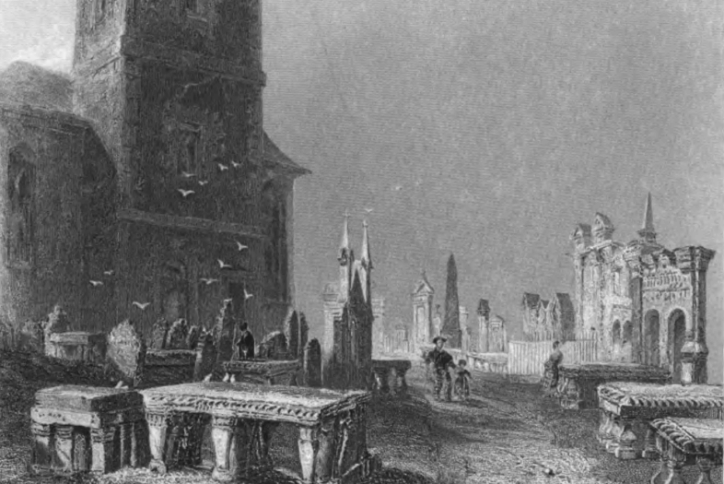
The last century was not far past its noon. Harpswell Neck, now a long cape, almost bare of trees, stretching out into Casco bay in unattractive barrenness, was then still thickly wooded; and only a path through the primeval forest connected the fishing settlement at its end with the small village gathered about the graveyard and the old square church, still standing, where Parson Eaton, or, as the country people universally called him, Priest Eaton, broke the bread of life to his sea-faring flock.
There had been grave doubts how Priest Eaton might feel about performing the last rites over the body that the women, angrily deserted by the men of the settlement, were wearily bearing to her grave. Hannah Stover had not only been a Quaker, causing great scandal by refusing to be present at the services in the old square church, but there were afloat rumors of a wilder and darker character concerning her. To the step-daughter, Mercy, who had been on the day previous to ask him, Priest Eaton had, however, given his promise, perhaps somewhat reluctantly, to overlook all short-comings in view of the well-established godliness of Elkniah Stover’s family; and her sorrowing husband hoped that no allusion to the religious wanderings of his dead wife might add to his pain.
While the women by their presence and by taking the office of bearers gave testimony to the worth of the departed, they were not without more or less conscious willingness that the occasion should be improved to their spiritual edification by some contrasting of their own steadfastness in the faith with the errors of the deceased. They had labored zealously with her living, and their characters were too hardy to yield all opposition simply because Goodwife Stover could no longer reply. They had braved the anger of the husbands that had forbidden them to be present at the funeral of one to whom popular malignity gave the name of witch, a name in those days of terrible import; but righteousness, and perhaps especially feminine righteousness, is seldom unwilling to hear itself commended, even at the expense of the unanswering dead.
As the forest began to grow thinner, and there were signs that the village was near, a certain subtle air of expectation made itself evident by faint signs. The bearers walked with a more alert step, the women behind drew their cloaks about them with an air half of protest and half of reproval, while Elkniah Stover’s daughter held more firmly in her own the trembling arm of her aged father, as she vainly tried to repress the growing agitation that made her own limbs unsteady and her throat dry and parched.
At length, between the trees appeared the heavy eaves of the meeting-house, and in a moment more the rough palings of the enclosure in which it stood with its graves about it, were brought in sight by the abrupt emergence of the path from a thicket of alders and arborvitae trees.
Beside the churchyard gate the women saw Priest Eaton, his somber robes of office blown by the chill November wind, and with a sudden surprise that made their hearts stand still, they saw, too, that he was not alone, but that around him in sullen groups were gathered the men of the Neck, whom their wives believed still at home in the settlement from which they had come.
For an instant the forlorn band of corpse-bearers half halted and wavered as if to turn back; then, obeying the instinct that makes women in a supreme crisis so inevitably turn to the priest, they carried the bier quickly forward and set it before the black-robed figure of Parson Eaton.
There was a moment of complete silence. Then Goodwife Mayo, with a deep-drawn sigh of fatigue, wiped her heated forehead upon the corner of her long, coarse cloak. The homely action broke the spell with which the strangeness of the situation had held them, and as if at a concerted signal, the men pressed forward. As they did so, a tall, gaunt man, with weather-beaten face and narrow eyes, spoke:
“Ye may take the witch-wife back,” he said, with a roughness that was partly genuine and partly assumed to help him overcome some secret, lingering weakness. “Let her lie in some of the black places in the woods where she would foregather with her master the Devil; but her wicked body shall never poison the ground where Christian folks are buried. No grave in consecrated ground for the likes of her.”
A hoarse murmur of assent, like the distant roaring of the surf on the ledges of white Seguin, answered him from the men. The women, half from habitual fear of their husbands and half from superstitious dread of the possibility of contamination from the dead, began to huddle together, drawing little by little away from the bier. Their eyes appealed to Priest Eaton to speak for them and to direct their course in an extremity so far removed from their ordinary experiences.
The dead leaves, hurrying before the wind, rustled at their feet, while in the air as a vague monotone was the distant sound of the soughing boughs and the waves beating upon the inhospitable rocks.
“Ezra Johnston,” the clergyman said in tones of solemnity, “who gave you the right to dictate who shall rest in consecrated ground? Are you the leader of God’s people?”
“No,” the other retorted, the angry blood fushing his swarthy cheek; “but when the leader of God’s people would let the Devil’s dam into the graveyard of our meetin’-house, it is a time when any man may speak. This woman could never be made to go through that gate while she was alive; why should she be carried through it, now she is dead?”
The murmur of approval swelled again, louder than before; and little by little the groups shifted, until Mercy Stover and her white-haired father were left alone beside the rough coffin.
“You were always hasty of speech,” Priest Eaton answered calmly, but with a certain stern dignity that belonged to his office in those days. “Who are you, to say who is worthy? Who made you a witch-finder?”
“I did not need to be a witch-finder to know Goodwife Stover for a witch,” was the stout reply. “I knew of her ways and her repute while still she lived in Freeport, and I warned Brother Elkniah against her. For that very thing she was hotly angered against me, by this token that my seine broke that same day I spoke as if every mesh in it were cut, and sorely hath she many times since tormented me with her witch-wiles. Ask Goodman Haskell, here, if he was not on my boat when she bewitched my killock so that all my strength was naught to move it until I made the sign of a cross on it. Ask — “
“I have heard,” interrupted the minister, “of your popish practices before; but they are not to be boasted of in open day unrebuked.” Elkniah Stover’s limbs had failed under him, as this strange colloquy went on, and he had sunk, a pathetic and broken figure, upon the handle of the bier. As he sat with one palsied hand, blue with the cold, resting upon the head of his staff, and the other clasping tightly the wrist of Mercy, he lifted his white head with a gesture of despair and anguish.
“Was it for this,” he wailed in a quavering voice of pain, “that the Lord gave me strength to rise from my bed and to follow the body of my helpmeet to the grave when a grave is denied her? Ezra Johnston was greatly angered, as ye all know, that after his sister that was my wife died I should go to Freeport for a helpmeet, when he would have had me choose the sister of his own goodwife. His killock caught under the thwarts. Waitstill Eastman can tell you that. But all that went amiss Ezra would still lay at the door of my goodwife; her that is here dead before ye, and ye deny her a grave away from the wolves.”
“She shall have her grave, father,” Mercy said, with an intensity of purpose that impressed even her angry uncle. “She shall lie by the side of my own mother if I have to bury her with no one to help me.”
The fickle sympathy of the bystanders veered in her direction, and one or two of the fish-wives that had formed part of the funeral train moved almost imperceptibly toward the spot where she stood, their action showing that the more merciful, at least, could not easily bring themselves to anything, so horrible to their mind as to deny burial to a fellow creature. Before, however, the movement could be at all general, even before it was marked, Ezra Johnston, whose always violent temper was fast mastering him, broke out again:
“Oh, no doubt Waitstill Eastman knows, and I am a blind fool that cannot see when his killock is free of the thwarts! Perhaps Goodman Eastman will say, too, that last Sabbath night I wasn’t haled in my sleep to the British bark off the point and dragged by the Devil’s imps up and down the sides till I was bruised and aching in every bone of my body. And I might have been killed but that daylight drew on, and with my own ears I heard Goodwife Stover say: ‘Let him go; ’tis almost cock-crowing.’ I knew her voice as well as I know my own, and that but two days before she died. What do ye say to that, Elkniah Stover? What do ye say to that, Parson Eaton?”
A dozen voices broke loose into a sudden babble. The unseemly and cruel debate that had thus far been carried on by single voices was all at once taken up by the whole company. The first surprise and awe had now worn off enough to let the folks recover the use of their tongues, and men and women hurried now clamorously to deny or to confirm Ezra Johnston’s charges. The clergyman tried vainly to make himself heard. His words were lost in the growing tumult. The crowd became every moment more and more like a mob. Johnston grew more and more furious, and his anger infected the men that were most under his influence. The very name of witch roused all the superstitious fears of the simple fishermen, and all the fanaticism of their blood was appealed to.
“Come,” Johnston cried out at last, struck with a sudden idea, “let us take the witch wife to the Devil’s Den, and leave her bones to rot there. I warrant she has been there times enough before.”
A shudder ran through his hearers. The Devil’s Den was a rocky cave on the shore of Harpswell Neck, where more than one good boat had perished, and where more than one fisherman had seen strange lights flitting about to cheat him to his destruction.
“Come,” repeated Johnston, taking a long stride toward the bier, “take hold here, some of you.”
But before he could grasp the rude handle, his niece sprang forward. Her eyes flashed; her simple hood fell back from her pale face, and her whole form quivered with excitement.
“Coward!” she cried. “Oh, you coward, you coward !”
Her voice, shrill and high, rang upward toward the heavy gray clouds as if it would call help down from heaven. The women shrank back in fear and the men in astonishment, while with arms stretched out in an unstudied attitude of appeal, and with an energy the more impressive by contrast with her usually calm and almost shy manner, Mercy poured out her protest.
“What has my mother done,” she demanded with a sort of sacred fury that stilled for the moment all murmurs and brought to the eyes of more than one tears, half of pity and half of excitement, “what has my mother done that you would treat her dead body worse than that of a dog? She has been more than a mother to me, and how many times she has helped the sick and the poor! Oh, are you the neighbors I have lived among all my life, and that have been kind to me, that I must beg for a grave for my mother, who was kinder and better than you all? And you, Uncle Ezra! Who saved your hand when it was frozen? Who doctored little Hope when she had the scarlet fever? You were glad enough to have her help when she was living, but now — ”
Her self-control gave way. She broke off in a burst of hysterical sobs, leaning her face upon the shoulder of her trembling old father. Ezra Johnston, for a moment giving way before his niece’s vehemence, covered his confusion with a sneer, and again attempted to seize the handle of the bier.
Before he could do more, however, a vigorous grasp caught his arm, and a stalwart young fellow drew him roughly back.
“Let be. Ezra Johnston,” the young man said in a deep voice, his strong, white teeth showing angrily. “Let be, or it will be worse for ye.”
Like a wildcat, Johnston turned to strike, but before the blow could fall, the clergyman sprang to catch the strong wrist of his angry parishioner.
“Stop!” Priest Eaton commanded in a voice of authority. “I warn you that you are going too far.”
Enraged as Johnston was, he was still sufficiently master of himself to realize that it was not safe openly to defy the clergyman, and it is not improbable, too, that he could not himself wholly shake off the habit of obedience that was almost universal in the scattered parish.
With any ally less powerful than superstition, it would have been idle for him to set himself against the minister on any question; but the remote pulses of the wave of madness that shook Salem in 1648 were more than a century in dying away, and in Harpswell the belief in witchcraft was as perfect as the faith in religion. Even today the superstition lives in many a remote New England village, and the air of the sea, laden as it is with mysterious sounds and influences, seems especially to nourish these delusions.
Johnston’s whole stubborn nature was by this time aroused, and all his cunning bent on the carrying of his point. He felt instinctively that the tide of general feeling was turning against him, and with genuine New England shrewdness he hit upon precisely the appeal that would most surely win the fickle crowd again to his views.
“Well,” he sneered, falling back, “if Jacob Thatcher takes the matter up, of course we must all give way, even if he wants an accursed witch-wife buried in the same lot with all the Christian folk we come of. Everybody knows that Goody Stover bewitched him long ago to make him run after Mercy; and ye, Daniel Strong, have cause to remember the luck she gave him. But if he takes sides with the Devil, the two together may well be too much for the honest men of Harpswell.”
The appeal produced an instant and powerful effect, and the angry retort of Jacob Thatcher was drowned in the cries of assent and approval that answered Johnston’s words.
That Thatcher was the lover of Mercy Stover was well enough known in a community where a man was hardly able to keep even his thoughts to himself, and the reference to this fact impeached at once the sincerity and impartiality of his interference. By alluding, moreover, to an old rivalry that extended to boats, athletics, and all interests that the narrow life of Harpswell permitted, and that Thatcher was always victor in, Johnston had secured for himself a powerful support. Not only Daniel Strong, but the young men generally smarted under a secret sense of defeat, while the coincidence between the universal success of the winner and his fondness for the witch’s daughter was exactly the sort of argument that appealed most strongly to the superstitious fisherfolk.
The crowd once more broke into speech, which was rather a babble than a clamor, and which became more angry as it swelled. The words of Priest Eaton were lost in the noise. Jacob Thatcher placed himself between the bier and his townsfolk, but even his stout shoulders seemed a slight enough barrier against sacrilege to the dead.
It was one of those chaotic and critical moments in the progress of a mob when it is broken into innumerable separate groups in angry dispute, and when it is idle to attempt to reach it as a whole until some striking incident unites once more its divided attention. It is usually true, moreover, that upon the first general impression that shall be exerted on a mob at such a crisis depends its action. It is at its most impressionable stage, and will readily take the stamp of whatever idea is strongly presented to it.
By this time, the crowd collected at the churchyard gate included almost every human being in the village, and it had assumed the character of a genuine mob. The remonstrances of Priest Eaton, the entreaties of Elkniah Stover, the appeal of Mercy, and the interference of Jacob Thatcher had all proved of no avail, and there seemed small hope but Ezra Johnston would carry his point, and that the body of the dead Quakeress would be cast in dishonor upon the jagged rocks of the Devil’s Den.
Help at this desperate crisis came from an unthought-of source. By one of those strange thrills that seem to reach the mind through some sense beyond the five, and to appeal to some faculty more subtle, the excited villagers became aware that something new had happened. A sudden hush spread over the wild company. Excited fishwives paused with open mouths in the midst of their haranguing, and stretched their necks toward the bier; the angry men broke off their noisy wrangling to turn their eyes in the same direction; even Mercy, who had clung convulsively to her father in the terror of seeing familiar faces transformed into strangeness before her eyes by superstition and rage, turned to look toward the coffin.
It was only old Goody Cole, who had at this critical moment made her tottering way up to the bier and flung herself down upon it. Lame and decrepit, weak and wandering in her wits, the poor old creature, whose stream of life had been so thin that for almost a century it had trickled on without draining even the ordinary measure of human existence, had only just been able to complete the journey from Harpswell Neck. All the long woodland track she had come, half tottering, half crawling, to lay her blessing upon Goodwife Stover’s grave.
In a wail that had in it the pathos of the sound of the wind in the forest, the wretched crone cried over and over, with heart-broken reiterance:
“Oh, but she was my life! Oh, but she was my life! Oh, but she was my life!”
The cry was so intense that it thrilled even the stolid fishermen of Harpswell Neck, perhaps for the time being rendered more sensitive than usual by unwonted excitement. The tension of their nerves became every moment greater, as they stood in unstudied groups, picturesque and strange. The brief November afternoon was darkening to its close, long lines of fiery light breaking the cold gray of the western sky. A few scant snow flakes were silently stealing through the air, falling upon the angry villagers, upon the tall form of Priest Eaton, with white locks and black gown, upon the strong, young figure of Jacob Thatcher, standing sentinel between his townsfolk and the dead, upon the pathetic group of father and daughter, and amid them all, that withered, century-old figure of Goody Cole, repeating in shrill monotone:
“Oh, but she was my life!”
They all understood that cry. There was no one there but knew well how long Goody Cole had been a pensioner on the bounty of Goodwife Stover. They might all remember, too, if they chose, that Goody Cole, whom they had left to the tender mercies of a woman they called a witch, was the widow of a man that had lost his life carrying help to a vessel on which were the fathers and husbands of people still alive and in this angry crowd. Goody Cole had been too proud to go on the parish, and her neighbors half a century ago had sworn that she should never come to want. Now, only the charity of this Quaker woman from Freeport had kept her from actual starvation.
“Oh, but she was my life!” quavered the trembling, aged voice over and over. “Oh, but she was my life!”
Pricked to the heart, two other women, almost young enough to be Goody Cole’s granddaughters, came out from the crowd and kneeled beside her, bowing their heads with sobs upon the coffin. There was a rustle and stir among the bystanders. They knew well enough what cause for gratitude these two had. Everybody knew all that happened on Harpswell Neck, and remembered now how to one of these women Goodwife Stover had come in the agonizing horror of child-birth, a saving angel; and how beside the bed of the second she had watched when a malignant disease kept every other woman on the Neck away.
“Oh, but she was my life!” shrilled Goody Cole, her voice rising in a thrilling strain which made the excited women shiver as if with cold.
The crowd of fishwives wavered. Then Goodwife Mayo, whose stout muscles had out-tired those of all the other bearers on the long march from Elkniah Stover’s cottage to the shadow of the square meetinghouse in which they stood, strode forward again to the coffin. She set her arms akimbo and looked about her.
“And ye, Betty Hincks,” she demanded, “who gave ye that cloak ye’re wearing this very hour? And ye, Martha Hastings, who brought ye through the fever last fall? And ye, Andrew Cates, who nursed your wife in haying-time? If Hannah Stover was a witch, well would it be for Harpswell Neck if we had more of them.”
“Oh, but she was my life!” came in the piercing cry of Goody Cole, like a refrain rising still higher and higher. “Oh, but she was my life!”
“Take up the bier,” Priest Eaton cried, with a gesture at once of dignity and of command. “Bury her wherever these men will. The ground will be consecrated wherever her body lies. Take it to the Devil’s Den,” he went on, the occasion inspiring him with unwonted fire, “and I tell you the Devil’s Den will be holy if Goodwife Stover’s corpse comes there!”
A wave of sudden feeling swept over the people like a mighty wind. As if obeying a common impulse, they rushed forward, with sobs and broken ejaculations, to raise the bier.
But Goodwife Mayo waved them back.
“No,” she said; “no man shall touch this bier. The women that have brought it so far in spite of their husbands’ orders can carry it the rest of the way!”
There was a murmur of mingled assent, contrition, and remonstrance; but it was in the end as Goodwife Mayo said.
Followed by all the men, even to Ezra Johnston, who scowled but yielded to the tide of feeling he could not turn back, the women of Harpswell Neck bore the body of Hannah Stover to her resting-place in the consecrated ground of the old graveyard.
“We have buried a witch,” Johnston muttered under his breath, as they left the sacred spot.
But in solemn rebuke Priest Eaton answered him:
“We have made the grave of a saint.”