FULL, of weariness, the young mother made a gesture of impatience.
“Let me alone, Ella!” she said in a tired, sluggish voice. “Go to your corner and play with your dolls. I have no use for you here just now.”
Over the chubby, rosy face of the little girl spread a troubled shadow.
Mamma was ever thus. She always sent her little one to her dolls, when she came near her, and yet Ella loved her beautiful mamma so much!
How gladly had she climbed into her lap and wound her small arms about her mamma’s neck and hugged her to her heart, just as little Marie, who lived on the third story, used to do to her mamma. Oh, what a good, good time little Marie had, although she did not wear nice clothes like Ella, nor get candy and other sweets; but, instead, her mother played and romped with her, and once, yes, once, Ella had seen how Marie’s mamma had pressed her little daughter to her heart again and again, and kissed her lips.
Ella’s mamma never yet did that; and yet she was so beautiful, much more beautiful than Marie’s mamma, who always wore the same dress of black stuff and never had bracelets or rings.
“We are poor,” Marie said, when Ella asked her once why she, too, did not go riding in a beautiful carriage, and why she had no big dolls like hers.
Poor! The child did not comprehend the meaning of this word. She was so accustomed to have things nice and elegant, that they were indifferent to her. Her little heart yearned so much for love, and just that was denied her. Her papa was good to her, of course, but he had so little time at his disposal; and the French nurse that she had was a peevish, unfriendly person, who liked best to read books and leave the child to herself.
And her mamma, her beautiful mamma! To her, little Ella seemed only to be a burden. When the child came to her every morning, she touched with a cold kiss her daughter’s luxuriant blonde hair. That was her only sign of tenderness.
After dinner, Ella was permitted each day to play for an hour with her doll in her mamma’s room, then she was dismissed and did not go to see her mamma again until the next morning.
A heavy sigh used to lift the gentle bosom of the child. The large blue eyes fixed themselves on the beautiful woman as she used to lie, folded in an elegant silk wrapper, on an ottoman. With soft hand, Ella was accustomed to stroke the expensive lace embroideries of its garniture. It smelled so sweet, it looked so pretty, so airy! Ah! if her mamma would allow her just once to play with the pale blue ribbons that peeped here and there through the laces so enticingly! Little Ella could not withstand the temptation. Yearningly she stretched out her little rosy fingers and took hold of the knots of ribbons. The young mother was aroused from her reveries by the touch.
“What! You are standing there yet?” she asked.
She was going to add a reproof, only the great baby eyes looked at her so beseechingly that she involuntarily continued in a milder tone:
“Do you want anything, Ella?”
The eyes of the child lighted up like two bright sunbeams.
“I would like — I wish, mamma, that you loved me a little,” she stammered, confused.
“I do love you, Ella,” she said, laying her hand lightly on the blonde head of the little girl.
“Very, very much, mamma?”
“Very much!”
The child drew a long breath.
“Then, then,” she asked, pressing her little hands together tightly, “then perhaps you will take me on your lap and kiss me, as Marie’s mother does her?”
The young mother slowly arose from her half-reclining position. For a few moments she stared fixedly at the little questioner.
“Mamma !” entreated the little one timidly.
Over the lady’s beautiful face flashed something like tenderness. She bowed herself to the child, and, closing Ella in her arms, lifted the tiny form to her lap.
“Are you satisfied now, Ella?”
“Oh, mamma,” cried the child exultingly, winding her arms around her mother’s neck, “how good you are, though! And how dear, how dear you will be to me for your goodness.”
The mother took the little blonde head in her delicate, slender hands and looked deep into the eyes of her daughter. Oh, it was the image of an unloved husband that met her gaze, mirrored in the rosy child-face.
She drew a deep sigh and then suddenly pressed a kiss on the little mouth.
“Now go, Ella,” she said gently, placing the child on the floor, “go and be a good girl. Mamma would like to be left undisturbed now.”
Obediently the child went to the corner to her dolls. A reflection of inward happiness rested on the sweet little face. Her mamma had never before been so good to her! While the child continued to play with her dolls, the young mother lay with half-closed eyes on the ottoman.
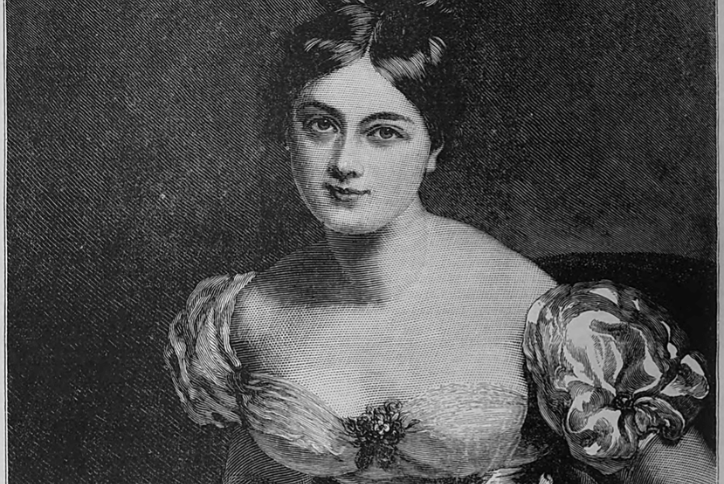
She was very handsome, this young wife of the wealthy manufacturer Reinhardt, and she was generally considered one of the most noted beauties of the capital, a recognition that she unquestionably deserved.
Manuela was very young when she became Reinhardt’s wife. She had counted hardly seventeen summers when her husband was, at least, twice that age.
Manuela’s father was a rich banker, who, through unfortunate speculations, became, one might almost say, in one night a beggar. He could not bear his loss and shot himself, leaving his widow and daughter in the most straightened circumstances. The family had been accustomed to live in elegant style, keeping a house celebrated for the brilliancy of its entertainments. Now penury and misery stared the two women in the face. All their friends drew back from them when misfortune overtook them.
One alone remained faithful, and he was Reinhardt. He took the forsaken ones under his protection and brought to order, so far as he could, their confused affairs.
Half a year after the catastrophe, Manuela became his wife. No mortal, not even her mother, guessed that she buried in her breast a youthful illusion, when she gave Reinhardt her hand.
Manuela had a cousin, a very young and handsome man, who, while she was hardly out of her baby shoes, used to trifle and toy with her in the way such young people are wont to do. He had thought of nothing when he used to whisper flatteries in the ear of his pretty cousin, or when he kissed her hand with boyish gallantry.
But Manuela had taken all these signs of tenderness very earnestly. Cousin Victor had remained the ideal of her maiden dreams, although he was removed and had to take his quarters in another garrison. The handsome lieutenant, with the blonde down covering his upper lip sank deep in her heart, and she shed many hot tears at his departure. Soon afterward, the misfortune happened to her family. Manuela had heard nothing more from her cousin.
As Reinhardt sued for her hand, her first impulse was to utter “no.” The still and earnest man had not understood how to win the sympathy of the young girl.
But Manuela was accustomed to a glittering existence, and the present condition of affairs weighed heavily upon her. Her mother, also, was delighted at this happy turn of things. Manuela herself had to confess that Reinhardt’s wooing was a piece of good fortune. She gave up the dreams of her girlhood and resolved to forget her cousin Victor.
In the beginning, she seemed to succeed in this very well. The novelty of her position, the return to riches, which had been painfully missed, all this worked so lively an influence, that she found no time to think of her lost happiness. Soon, however, it was different. Manuela’s mother sickened, and died after a short illness.
The young wife felt herself suddenly isolated, and, during the time that her mourning compelled her to avoid society, the memories of the past crowded upon her with double force. She thought more than ever of her young and handsome cousin, whom her earnest and quiet husband resembled in nothing, and deeper and deeper Victor’s image stamped itself on her heart.
She had no idea how fervently, how tenderly, her serious husband loved her. She saw in him only the one that had robbed her of her freedom, that had thrust her in a gilded cage, as one guards a rare and brilliant bird, in order to have an ornament for his house, and a deep resentment took possession of her. She became ever colder, ever more repellent to her husband; and Reinhardt was too proud to sue further for a heart that felt for him no warmer sentiments. He gave himself up completely to his business, and left the young wife to herself.
This neglect, as she called it, embittered Manuela still more. At the bottom of her heart, it pained her to believe that she had been married simply because she was beautiful. She became a mother, but she showed little affection for her child. It was his child, too, and the more little Ella grew, the more striking became her resemblance to her father. From the mother she got alone the beautiful blonde hair and the great blue eyes.
Ella was handed over to strange hirelings, and her handsome mother, afterwards as before, went her own way. She was not at all coquettish, and soon she found no longer any enjoyment in the intoxicating whirl of social pleasures that surrounded her. Only what could she do?
She felt impelled to go on in order to forget her domestic misery; perhaps, also, to deaden the inward voice that sometimes kept whispering to her warningly:
“You have from the very beginning badly fulfilled the duties of a wife. It should have been your part to have made your own the heart of your husband, with gentleness and kindness, instead of showing him, as you have, coldness and indifference. Without compromising your womanly dignity, you could have been friendlier and more amiable, and many a thing would have been different.”
But Manuela was deaf to this voice. It was not her part to sue for love; it was the part of her husband, who had chosen her, and that he did not do it hurt her more than she was willing to confess.
Thus had she dragged along the yoke of her unhappy marriage four years, when Victor returned to the capital.
The young and good-looking lieutenant had become an elegant officer. “The handsome captain,” people used to call him; and he was indeed a very attractive man.
His polished and high-bred demeanor assured him everywhere a favorable reception from the ladies, and although the men found him in many respects not exactly to their taste, he had all the women on his side.
What Manuela felt at seeing him again, no words can express. Joy and an undefined sentiment of fear disputed actively in her soul. The long, somewhat too bold look of admiration that the captain gave her drove the blood to her cheeks and caused her heart to beat tumultuously. Had Victor forgotten his former affection for her? Or — she dared not think of it! and yet he came back ever to her mind — what could, what would come of it?
It was natural that Reinhardt should open his house to the cousin of his wife. The captain came pretty often; and also in society he was seen most frequently at Manuela’s side. And yet no word of calumny dared to make busy with her name. The cold and reserved carriage of the young wife excluded in advance any shadow of suspicion.
Even the handsome captain, who had thought to come to see and to conquer, found himself somewhat mistaken. Manuela’s repose led even him astray, and her apparent coldness caused the fire to flame up more fiercely in his heart.
But Victor’s affection did not resemble Manuela’s. He loved merely the beautiful woman, while she still saw in him always the dear companion of her childhood. He had forgotten long ago the triflings of past years, while she held to their sweet memories with all her strength.
It was that only, in her eyes, that excused the sudden passion flaming up in her heart. She would not acknowledge to herself that her husband’s indifference had anything to do with it; whether Reinhardt loved her or not, it did not matter.
Thus an entire year passed since the captain’s coming, and he did not yet understand the exact footing on which he stood with Manuela. Sometimes it seemed to him as though her eyes met his with love, but directly thereafter she would encounter his glances with such coldness and repose that he lost every illusion.
His sighs, his half-whispered words, remained unheeded; and yet it seemed to him again as though she listened gladly to these confessions that came in sweet, caressing tones from his lips.
While the child played quietly in her corner, Manuela was dreaming of her love which took her whole being captive, which offered her the happiness that, until now, her married life had failed to give her.
“Why, why had Reinhardt never shown her such tenderness, such affection!”
Horrified at her own thoughts, she sprang up. Why did the image of this man always mingle in her reveries? Indeed, she did not care for him, and she — oh, she hated him!
She arose and went to the child.
“Go to your nurse now, Ella,” she said.
The little one looked up to her entreatingly.
“ Mayn’t I stay just a little while? I will be so good, mamma!”
“No!”’
Her tone was so short, so coldly repellent, that little Ella caught up her dolls in silence and sadly slipped out of the room.
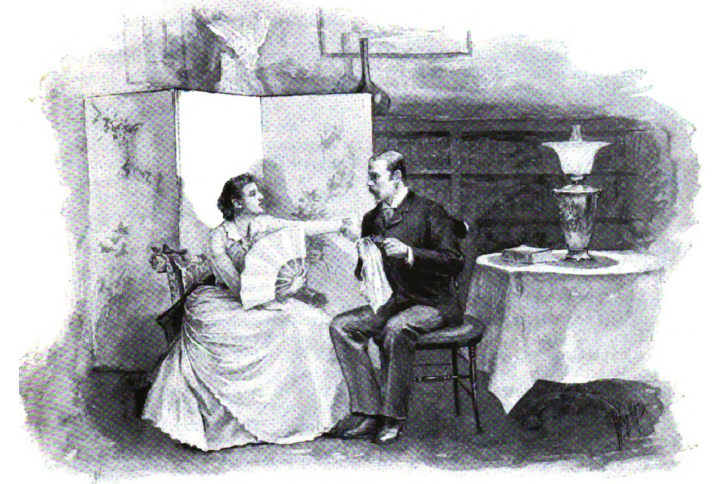
Manuela gazed after the pretty little form as it disappeared behind the portiere. She was just going to call the child back to her, but she quickly restrained the impulse. There, leaning against the door that led into her small reception room, was the captain. The young wife involuntarily pressed both hands on her wildly throbbing heart.
“How did you come here?” she asked, looking down confused at her négligée. “Why did you not have yourself announced?’’
“I found no one in the anteroom,” he answered, slowly drawing nearer.
“Unpardonable carelessness!” cried the young wife, trembling in every limb.
“ Manuela,” he interrupted, in passionate tones, “how charming you look in those airy garments!”
Manuela became pale. Her husband never had this tone of rapture for her, and yet he saw her every day “in those airy garments.”
She gave no answer. A terrible dread took possession of her. She felt that this hour would be decisive, and she shook with emotion. The captain had seized both her hands in his and was pressing his burning lips upon them.
“Leave me, Victor,” she moaned.
“No, no, no! For I love you. I love you, and will dare everything, providing I may call you mine!”
He tried to embrace her, but she stepped back. Then he fell before her on his knees. Glowing and passionate words burst from his lips, and she listened to them with heightened color in her cheeks.
Did this wild and stormy speech find a response in her breast? Singular, while she listened with quickened pulse and heaving bosom to Victor’s words, the earnest face of her husband rose before her eyes. Why had he never addressed her thus?
Because he did not love her; because she was for him merely a beautiful statue to adorn his mansion. No more; no less. She sighed and drew away her hands from Victor’s.
“Stand up!” she said. “I will not hear you further!”
But the ice was broken. The captain understood women too well not to know that Manuela was already half conquered. A proud, triumphant smile played around his lips as he left Reinhardt’s house.
After this, Manuela listened readily to his assurances of love. She heard him in silence when he arranged a plan of flight, and tried to persuade her to leave the house of her husband. Why not? What did she want at the side of this man? But to lie, to deceive and betray him — she was too proud for that. If she broke faith with him, everybody should know it. She was not afraid of publicity. If he had a treasure, why did he not esteem it enough to guard it better?
The captain’s intention was to take a long furlough and to go with her to sunny Italy. Reinhardt had to leave the city for several days, and Manuela was to take advantage of this to leave his house forever.
The captain had received permission to absent himself from his military duties for a longer time, and had arranged all his affairs, so that nothing more remained in the way of their flight. Nevertheless, Manuela put off the time of the carrying out of their plan until the evening before Reinhardt’s return.
No matter how impetuously Victor begged, she stood firm. It was as though she were loath to depart, as though she could not tear herself away from the house where she had been mistress so many years.
And her child, her little Ella! The thought of her little girl, who had enjoyed so meager a portion of her affections, weighed often heavily on her heart. Should she take the child with her? Had she a right to do it — she who, trampling under foot every consideration, was about to desert her husband in secret?
No, Ella must stay with her father. The child would bring him too much to her remembrance. As soon as she left Reinhardt’s house, every tie must be severed. Indeed, it were better so!
But she would not refuse herself one parting kiss. She had lately occupied herself more with the child, and a warmer feeling toward her had grown up in her heart, feelings that she herself did not understand; but as she now stood, in that late hour of the night, before the bed of the sleeping child, a wild and overwhelming sense of sorrow convulsed her.
It was her child, too, although the features were those of an unloved husband. It was her own flesh and blood, and she was going to forsake it now, never, never to return! She bowed herself over the sleeping child and hot tears dropped on the blonde tresses.
Ella moved uneasily from side to side. Her cheeks were of a dark red color, and the little hands that Manuela gently and lightly touched were burning hot.
The young mother gazed at her child anxiously. Between the half-opened lips that looked like two tender rose petals, the breath came quick and irregular. The bosom rose and fell with an effort, and now came, hoarse and broken, from Ella’s mouth:
“Mamma, mamma!”
Forgetful of everything, Manuela bent her head low down to the little girl.
“Ella, my darling Ella!” she cried.
Then two full, round arms wound themselves tightly around her neck, two great blue eyes opened wide, and a half-smothered child’s voice whispered:
“Mamma, mamma, stay!”
“I will stay with you, my darling! I will stay with you!” Manuela sobbed, pressing her little daughter to her breast. “I will be a better mother to you than I have been. But, Ella, my darling, what ails you, say?”
A hollow rattling in the throat was the only answer. The blue eyes closed and the little one sank back, seemingly lifeless. Manuela called anxiously for the nurse, who slept in the adjoining chamber, and whose door stood open.
Some time passed before the sleepy Frenchwoman was aroused. She was much astonished to find her mistress, in the middle of the night, at the little girl’s couch. But Manuela gave her no time to express her wonder in words. She commanded her, in a voice tremulous with terror, to send immediately for a physician and to awaken one of the servants. Ella had been taken suddenly ill.
Then she turned again to her daughter, who lay in a high fever.
She gave no thought to the circumstance that the captain was waiting for her at the next street corner with a carriage to convey her to the railroad station; that she ought to have been there long ago, if she did not wish to miss the night train. She thought of nothing, nothing but her sick child.
The physician shook his head gravely. Ella was in the grasp of one of the most dangerous diseases known to childhood. While Manuela sat, pale and distressed, at the bed of her child, the captain was announced.
A shudder overran the form of the young wife. Was he coming to remind her of her promise?
“I receive no one,” she said shortly and sternly to the servant. “Tell the captain I cannot leave my sick child.”
The servant went, but returned immediately. The captain begged for just one moment, a pressing affair. Then Manuela arose with her blue eyes glittering with anger, but she controlled herself. She cast one long look once more on the child, as she left the room with firm step.
In the small reception room, the captain advanced impetuously to meet her.
“Manuela, what does this mean? Why did you keep me waiting yesterday in vain?”
She looked at him proudly.
“Because I did not wish to go with you,” she said slowly. “Because I have learned to see my fault, and because I cannot leave my child.”
“You intend, then, to wait until her recovery?” he asked in an irritable tone.
“I had not expected to find you so sentimental.”
Her lips curled in a contemptuous smile.
“You have misunderstood me. I shall never forsake this house willingly!”
“Manuela!” He stepped towards her passionately, and sought to seize her hand, but she waved him back.
“All is over between us,” she said, drawing a long breath. “Forget me, and avoid this house in the future.”
“Do you really mean it?” he cried, more enraged than wounded. “So you have been only playing with me, and I have been the victim of your mockeries!”
“Believe whatever you will,” she answered, her blue eyes fixed full upon him.
“We are henceforth strangers to each other.”
She bent her head slightly and was about to withdraw, when he stepped hastily in her way.
“No, no, Manuela!” he said in a voice trembling with anger, “ you do not cast me off so easily. Answer me! Why do you wish to give me up?”
“Leave me! I must go to my child.” He caught her violently by the arm.
“Stay, Manuela! I must hear your reasons!’’
“I wish to make atonement for my errors in becoming a good mother to my child, if God will let her remain with me,” she cried, growing very pale; “and now this is She tried to loosen herself from his grasp, but he held her fast.
“Manuela,” he entreated, contemplating her with burning glances, “I love you so fondly!”
“Let me go, or I will call for help!”
He released her without another word. For a few moments longer, they gazed in each other’s eyes, she proud and cold, he angry and stern; then both turned at the same time to go.
Manuela returned to the sick room. The captain went directly to the railroad station and left the city on the next train.
As Reinhardt came back that evening, Manuela sprang to meet him.
“At last, at last!” she cried in a voice choked with tears, throwing herself wildly into his arms, “the doctor has just said that there is hope!”
Reinhardt, astonished, clasped his sobbing wife in his arms. What had taken place during his absence? His wife had never met him thus before.
With gentle words, he sought to quiet her and then he learned of Ella’s illness, and that the danger was happily over. He could hardly believe his senses, such a change had taken place in Manuela’s manner and bearing toward him.
With what tender care she nursed her little daughter! With what love her eyes rested on the sweet face of the child!
Was Reinhardt made the sport of a dream, or would it remain this way always? The solution of the riddle became known to him as they sat that night by each other, watching over the sleep of their daughter; for Manuela, although completely worn out, refused peremptorily to surrender her position at the bedside of the little patient. Sweetly and restfully, Ella slept. The mild light of the night lamp fell on her face, down upon which both parents gazed tenderly.
Restfulness and peace lay on the little face. Restfulness and peace entered the heart of Manuela also. She found sufficient courage to tell her husband all, and to beg his forgiveness. No false shame held her back from being truthful and open with him; for she felt that an honorable confession alone could make her worthy of his confidence.
When she ended, he held her hands with a gentle pressure.
“Why did you want to leave me, Manuela?”
“Because I felt myself lonely and forsaken; because I knew you did not love me,” came passionately from her lips. “You passed me by so coldly, without making an effort to win my heart!”
“Look at me!”
Slowly she lifted her glance. What did she read in his eyes? What did he in hers? She lowered her head to his breast silently; his arms enfolded her.
“I will try to win your love,” he said.